


If you’re searching for where to watch Alabama Crimson Tide football vs. Oklahoma Sooners football, several viewing options may be available, including cable television, live TV streaming services, and official radio broadcasts. The best choice depends on your location, subscription package, and the game’s confirmed broadcast details. Checking the TV channel, streaming availability, kickoff time, and official schedule before game day can help you avoid last-minute problems.
Whether you’re watching from home or following the action while traveling, choosing an authorized broadcaster or licensed streaming platform can provide reliable coverage, quality video, and expert commentary where available. Make sure your device is compatible, your internet connection is stable, and your chosen service carries the correct channel. With a little preparation, you’ll be ready to enjoy the excitement of Alabama vs. Oklahoma from kickoff to the final whistle.
What Is a Safety in Football?
A safety is one of the most unique and valuable scoring plays in American football. While it doesn’t happen as often as a touchdown or field goal, it can significantly change the momentum of a game by awarding points to the defense and giving them possession of the ball. Understanding what is a safety in football is essential for anyone who wants to learn the game’s scoring rules and overall strategy.
rewrite kro
Definition of a Safety
The simplest way to understand what a safety in football is is to recognize it as a defensive scoring play worth two points. A safety occurs when the offensive team causes the ball to become dead in its own end zone under specific American football rules. Unlike touchdowns and field goals, which are typically scored by the offense, a safety allows the defense to earn points directly. One common example is when a quarterback is tackled in his own end zone while attempting to make a play.
A safety can also result from certain offensive penalties, such as intentional grounding or holding committed in the end zone, or when the offense causes a loose ball to go out of bounds behind its own goal line. In the football scoring system, a safety awards two points to the defensive team and is followed by a free kick from the team that conceded the score. This gives the scoring team an opportunity to regain possession and potentially benefit from favorable field position.
Why It Is Called a Safety
Many fans wonder about the origin of the term “safety” in American football. The name is commonly associated with situations in which a team would accept giving up two points rather than risk a more damaging outcome, such as a turnover or a scoring play by the opponent. This connection to choosing a less costly outcome helps explain the term’s place in football terminology.
Although the game has evolved over time, the term safety remains an important part of its rules. Today, intentionally allowing a safety is generally uncommon because it awards the opposing team two points and is followed by a free kick. The rule also limits an offense’s options when defending its own end zone, adding another layer of strategy and helping maintain competitive balance throughout the game.
Read Also: Where to watch Spain national football team vs the France national football team.
How Does a Safety Happen?
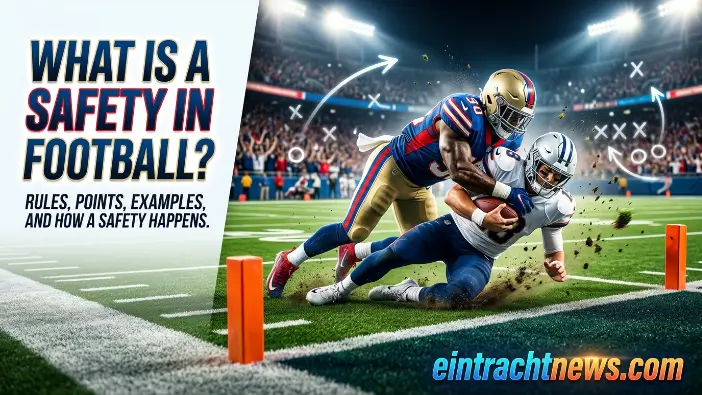
A safety in football can occur in several ways, but the key factor is that the offensive team is responsible for the ball becoming dead in its own end zone under specific rules. When this happens, the opposing team earns two points, and the team that conceded the safety must restart play with a free kick. While a quarterback being tackled in his own end zone is the most well-known example, the official rules of American football include several other situations that can also lead to a safety.
Quarterback Tackled in the End Zone
This is the most common way a safety occurs. It usually happens when the offense starts a play close to its own goal line, and the quarterback drops back to pass. If defenders break through the offensive line and sack the quarterback before he can throw the ball, and the tackle takes place inside the end zone, the defense earns a safety.If the quarterback drops back to pass and defensive players break through the offensive line to sack him in his own end zone, the play can result in a safety, awarding the defense two points.
This type of play often occurs because of:
- Strong defensive pressure
- Missed blocking assignments
- Effective pass-rushing techniques
- A well-timed blitz
- Poor decision-making by the quarterback
A sack in the end zone can dramatically shift the game’s momentum. Not only does the defense earn two points, but the resulting free kick also gives it an opportunity to gain possession and improve its field position.
Offensive Penalty in the End Zone
Not every safety results from a tackle. Certain offensive penalties committed inside the team’s own end zone automatically result iA safety can also occur when the offense commits certain penalties in its own end zone while attempting to avoid a loss of yardage or a sack.
Common examples include:
- Offensive holding
- Intentional grounding
- Certain illegal blocking fouls
For example, if a quarterback intentionally throws the ball away from inside his own end zone to avoid being sacked, officials may call intentional grounding if the play meets the conditions for that penalty. Because the foul occurs in the offense’s end zone, the defense can be awarded two points for a safety under American football rules.
Ball Carrier Downed in the End Zone
A safety can also happen when an offensive player carrying the ball is tackled in his own end zone. This situation may occur when a running back, quarterback, or another ball carrier moves backward while trying to avoid defenders but is stopped before escaping the end zone.
If the ball becomes dead in the offense’s own end zone and the offense is responsible under the rules, the opposing team is awarded a safety worth two points. This gives the defense a scoring advantage and can shift the momentum of the game.
Loose Ball Out of the End Zone
Another less common situation that can result in a safety involves a fumble. If an offensive player loses control of the ball near their own goal line and it rolls into the end zone before going out of bounds, the opposing team may be awarded a safety if the offense is responsible for the ball entering the end zone.
Although these situations are uncommon, they highlight the importance of ball security in football. Coaches consistently stress the need to protect the football, especially near their own goal line, because one costly mistake can award the opposing team two points and possession of the ball through the ensuing free kick.
How Many Points Is a Safety Worth?
Although a safety is one of the rarest scoring plays in football, it can significantly influence the outcome of a game. In addition to adding points to the scoreboard, it gives the opposing team an opportunity to regain possession through a free kick. This makes a safety a valuable defensive achievement in American football. Understanding how many points a safety is worth and what happens after the play provides a clearer picture of the overall football scoring system.
Two-Point Safety Explained
If you’re learning what is a safety in football, one of the first things to remember is that a safety is worth two points. Whenever the defense forces the offense into a safety situation, the defensive team immediately adds two points to its score. While two points may seem small compared to a touchdown, they can completely change the outcome of a close game. In fact, many NFL and college football games have been decided by a single safety because every point matters.
Unlike a touchdown or field goal, a safety is scored by the defense rather than the offense. It usually happens because of strong defensive pressure, smart positioning, or an offensive mistake near the end zone. Since the scoring team also receives the ball after a safety, this play provides both points and a chance to build on its advantage, making it one of the most valuable defensive achievements in football.
Here’s a comparison of common scoring plays in the football scoring system:
| Scoring Play | Points Awarded |
| Touchdown | 6 |
| Extra Point Kick | 1 |
| Two-Point Conversion | 2 |
| Field Goal | 3 |
| Safety | 2 |
Although a safety and a two-point conversion are both worth two points, they happen in completely different ways. A two-point conversion is scored by the offense after a touchdown, while a safety is earned by the defense when the offense makes a mistake in its own end zone.
What Happens After the Safety?
Once a safety is awarded, the game does not restart with a regular kickoff. Instead, the team that gave up the safety must perform a free kick froAfter a safety, the scoring team receives a free kick from its own 20-yard line. Depending on the rules and the team’s strategy, the kick may be executed as a punt, drop kick, or place kick.
This rule gives the scoring team an opportunity to regain possession with favorable field position, potentially creating another scoring opportunity soon after the safety.
A safety offers several key advantages:
- Two points added to the scoreboard
- Possession of the football following the free kick
- Improved field position for the next offensive drive
- A momentum shift that can influence the game’s outcome
For these reasons, coaches emphasize making smart decisions and protecting the football near their own goal line. A single mistake in the end zone can award the opposing team two points and a chance to take control of the ball, making a safety a costly setback in football.
Safety vs Touchback
At first glance, a safety and a touchback may seem similar because both involve the football ending up in the end zone. However, they are completely different situations with different rules and outcomes. A safety results in points for the defense, while a touchback simply determines where the next offensive drive will begin. Understanding this difference is important because many new football fans often confuse these two plays.
Key Differences
A safety occurs when the offense is responsible for making the ball dead inside its own end zone. This can happen if the quarterback is tackled in the end zone, an offensive player commits certain penalties there, or the offense causes the ball to become dead in the end zone. When this happens, the defense is awarded two points, and the offensive team must perform a free kick from its own 20-yard line.
A touchback, on the other hand, does not award any points. Instead, it occurs when the ball becomes dead in the end zone under legal circumstances, allowing the receiving team to start its offensive drive from a designated yard line.
Common examples of a touchback in American football include:
- A kickoff enters the end zone and is not returned.
- A punt rolls into the end zone and remains there.
- A defensive player intercepts a pass in the end zone and decides not to run the ball out.
In these situations, officials may rule a touchback when the play meets the relevant rules. Unlike a safety, a touchback does not award points to either team.
Comparison Table
| Feature | Safety | Touchback |
| Points Awarded | 2 | 0 |
| Which Team Benefits? | Defense | Receiving/Defensive Team |
| Change of Possession | Yes | No immediate scoring change |
| Usually Happens Because Of | Offensive mistake | The ball becomes dead in the end zone, legally |
| Momentum Impact | Very High | Moderate |
The easiest way to remember the difference is simple:
- A safety gives the defense two points and possession of the football through a free kick.
- A touchback gives no points and only determines where the next offensive drive will start.
Safety (Score) vs Safety (Player Position)
When understanding what a safety in football is, beginners often confuse the two meanings of the term “safety.” In American football, it can refer to a scoring play that awards the defense two points, or it can describe a defensive player position. Although both use the same name, they serve very different purposes in the game. Understanding this distinction makes it easier to follow football rules and learn how the game works.
What Does a Safety Position Do?
A safety is one of the deepest defenders on the field and is part of the defensive back unit. Since safeties usually line up behind the cornerbacks and linebackers, they are often called the last line of defense. Their main job is to prevent the opposing team from making big plays, especially long passes or breakaway runs.A safety needs excellent speed, strong awareness, effective communication, and reliable tackling skills to recognize offensive plays before they fully develop. Depending on the situation, a safety may cover receivers, support the defense against running plays, or provide additional protection against passes.
The primary responsibilities of a safety include:
- Defending against deep passes
- Supporting cornerbacks in pass coverage
- Stopping long runs by offensive players
- Reading the quarterback’s movements and decisions
- Providing support against running plays
- Preventing the offense from scoring touchdowns
Because safeties contribute to both pass defense and run defense, they are among the most versatile and valuable players on an American football defense. Their ability to anticipate plays, cover open spaces, and make crucial tackles can significantly influence the outcome of a game.
Free Safety vs Strong Safety
Most American football teams have two starting safeties, each with specific responsibilities based on the team’s defensive formation and overall strategy. These positions are typically known as the free safety and the strong safety, and each plays a key role in protecting the defense against passes and running plays.
Free Safety
The free safety usually liA free safety must read the offense, anticipate where the ball is likely to go, and provide support to cornerbacks when necessary. This player typically lines up deeper in the secondary, helping protect the defense against long passes and dangerous offensive plays.
The main responsibilities of a free safety include:
- Defending against deep passes
- Reading offensive formations and recognizing potential plays
- Supporting cornerbacks in pass coverage
- Preventing big plays by the offense
- Intercepting passes when opportunities arise
Because of these duties, a free safety depends heavily on speed, anticipation, and football intelligence to recognize threats quickly and make effective defensive plays.
Strong Safety
The strong safety normallA strong safety typically lines up closer to the line of scrimmage and plays a more active role in stopping the running game. This position requires a physical, athletic player who can make reliable tackles while also covering receivers, particularly tight ends.
The main responsibilities of a strong safety include:
- Supporting the run defense
- Covering tight ends and other receivers
- Blitzing the quarterback when needed
- Making tackles in open space
- Providing additional support to linebackers
A strong safety combines physical strength, tackling ability, and athleticism to defend effectively against both running and passing plays. Their versatility makes them an important part of a team’s overall defensive strategy.
Why a Safety Can Change a Game
Although a safety is worth just two points, its impact extends well beyond the scoreboard. Unlike most scoring plays, a safety is followed by a free kick that gives the scoring team an opportunity to regain possession of the football. This creates an immediate strategic advantage by affecting both the score and field position. As a result, a safety can shift the momentum of a game and potentially play a decisive role in determining the final outcome.
Momentum Shift
Football is a game driven by momentum, and few defensive plays can be as impactful as a safety. Picture an offense pinned deep in its own territory, close to its end zone. Rather than advancing the ball, the team concedes two points to its opponent and must then give up possession through a free kick.
This sudden shift can boost the defense’s confidence while putting the offense under immediate pressure to respond. A safety can energize players, coaches, and fans alike, changing the game’s momentum in a single play. In tightly contested matchups, that shift can become a decisive factor in determining the winner.
Field Position Advantage
Another key advantage of scoring a safety is the favorable field position that can follow. After a safety, the team that conceded the points must kick the ball from its own 20-yard line. This often gives the receiving team a chance to begin its next drive with strong field position, potentially near midfield or in the opponent’s territory.
Combining two points with a favorable starting position can create an excellent opportunity for the scoring team to increase its lead. For this reason, coaches recognize the value of a safety and encourage aggressive defensive play when the opposing offense is backed up near its own goal line.
Famous NFL Safety Examples
Throughout NFL history, several memorable games have featured safeties that dramatically shifted momentum. One famous example occurred in Super Bowl XLVIII, when the opening snap sailed over the quarterback’s head and out of the back of the end zone. The mistake resulted in a safety just 12 seconds into the game, making it one of the quickest scoring plays in Super Bowl history.
Examples like this demonstrate that a safety is worth more than just two points. It can change momentum, provide a field-position advantage, and influence the entire course of a game. Understanding what is a safety in football helps fans recognize why every play near the goal line can have such a significant impact.
Common Mistakes People Make About Safeties
Even experienced sports fans sometimes misunderstand how a safety works. Since the word “safety” has multiple meanings and the play doesn’t happen very often, it’s easy for beginners to get confused. Knowing the facts behind these common misconceptions will help you better understand American football rules and enjoy the game with greater confidence.
- Confusing a safety with a touchback. A safety awards two points to the defense, while a touchback awards no points and simply determines where the next drive begins.
- Thinking a safety is worth six points. Only a touchdown is worth six points. A safety is always worth two points.
- Mixing up the scoring play with the player position. The term “safety” can refer to a defensive scoring play or a defensive back position. These meanings are completely different.
- Believing only quarterbacks can give up a safety. Any offensive ball carrier can be tackled in the team’s own end zone, resulting in a safety if the rules are met.
- Assuming safeties happen often. Compared with touchdowns and field goals, safeties are relatively rare because offenses work hard to avoid dangerous situations near their own goal line.
By understanding these common mistakes, you’ll have a much clearer understanding of what a safety is in football and be able to recognize this unique scoring play whenever it happens during a game.
Tips for Understanding Football Safeties
If you’re still learning what is a safety in football, recognizing one durin Recognizing a safety during a live football game may seem challenging at first. However, once you understand the basic rules and know which situations to watch for, identifying a safety becomes much easier. The following tips can help you recognize when a safety might occur.
- Watch plays near the offense’s own goal line. Teams positioned deep in their own territory are more vulnerable to giving up a safety.
- Look for intense defensive pressure. Powerful pass rushes and blitzes can force quarterbacks into mistakes that may lead to a safety.
- Understand the end zone rules. Knowing when the ball becomes dead inside the offense’s own end zone helps you determine whether a safety has occurred.
- Pay attention to offensive penalties. Certain infractions, including intentional grounding and offensive holding in the end zone, can result in a safety.
- Review game replays. Replays can clarify why officials awarded a safety and help you understand how the rules apply.
- Distinguish between a safety and a touchback. Both involve the end zone, but they have different rules and outcomes. Understanding the difference helps prevent a common mistake among new fans.
- Listen to experienced commentators. Broadcasters often explain unusual plays and the rules behind them, making it easier to learn while watching.
The more football you watch, the more familiar these situations will become. With practice, you’ll be able to recognize a safety more quickly and better understand its impact on the game.
Frequently Asked Questions
Is a safety worth 2 points?
Yes. A safety always awards two points to the defensive team. Afterward, the team that conceded the safety must perform a free kick from its own 20-yard line.
What happens after a safety?
Following a safety, the team that gave up the points kicks the ball to the opposing team using a free kick. This gives the scoring team both two points and possession of the football.
Can a defense score a safety?
Absolutely. In fact, a safety is one of the few scoring plays earned directly by the defense. It usually results from tackling the offensive ball carrier in the offense’s own end zone or from specific penalties.
What is a one-point safety?
A one-point safety is an extremely rare rules situation that can occur during a conversion attempt after a touchdown. It is almost never seen in regular games because it requires a very unusual sequence of events.
What is the difference between a safety and a touchback?
A safety awards two points to the defense because the offense caused the ball to become dead in its own end zone. A touchback awards no points and simply places the ball at the appropriate yard line to begin the next offensive possession.
Conclusion
Now that you understand what is a safety in football, you can appreciate why this unique scoring play is so important. A safety awards the defense two points, leads to a free kick that gives the opposing team possession, and can create a significant momentum shift that influences the outcome of a game.
Whether caused by a quarterback being tackled in the end zone, an offensive penalty, or another costly mistake, a safety highlights the value of disciplined defense and effective strategy. By understanding how a safety differs from a touchback and learning its role in the football scoring system, you’ll be better equipped to follow American football and enjoy every game with greater confidence and knowledge.
