

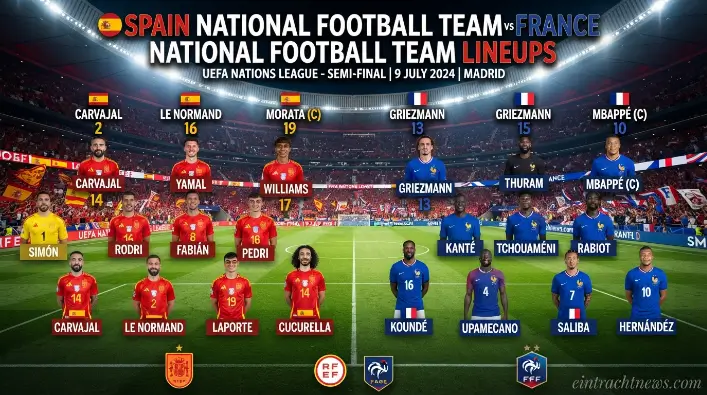
Welcome to Eintracht News. The Spain national football team vs France national football team lineups were officially confirmed for the 2026 FIFA World Cup semi-final on July 14, 2026. Spain named Unai Simón as their starting goalkeeper, while France selected Mike Maignan between the posts. Both sides featured strong starting XIs packed with talented and experienced players.
Spain lined up in a 4-1-2-3 formation, while France opted for a 4-2-3-1 setup. Spain controlled much of the match and secured a 2-0 victory. Mikel Oyarzabal opened the scoring from the penalty spot before Pedro Porro scored Spain’s second goal to seal the win.
Spain vs France Lineups at a Glance
| Detail | Spain | France |
| Competition | 2026 FIFA World Cup | 2026 FIFA World Cup |
| Round | Semi-final | Semi-final |
| Formation | 4-1-2-3 | 4-2-3-1 |
| Result | 2 goals | 0 goals |
| Venue | Dallas Stadium | Dallas Stadium |
The Spain vs France lineups featured two contrasting tactical approaches in the semi-final. Spain set up in a 4-1-2-3 formation and named the same starting XI that had featured in their previous match, allowing the team to build on its established chemistry and consistency. France, on the other hand, used a 4-2-3-1 system and made two changes to their lineup, with Bradley Barcola coming into the attack and Aurélien Tchouaméni returning to midfield.
Spain went on to secure a 2-0 victory, with their consistent lineup and tactical structure helping them control important phases of the match. Their selection also allowed them to make the most of key opportunities and maintain their advantage throughout the semi-final.
Spain National Football Team Starting XI
Spain’s starting XI featured a balanced mix of defensive solidity, midfield creativity, and attacking quality. Unai Simón started in goal, while Pedro Porro, Pau Cubarsí, Aymeric Laporte, and Marc Cucurella formed the back four. In midfield, Rodri played a key role in protecting the defense, with Fabián Ruiz and Dani Olmo helping Spain control possession and create attacking moves.
Lamine Yamal and Álex Baena provided width from the flanks, while Mikel Oyarzabal led the attack as the central striker. The lineup gave Spain a flexible structure, allowing them to remain organized defensively while creating chances in the final third.
Spain Starting XI and Player Positions
| Position | Player | Role |
| GK | Unai Simón | Goalkeeper |
| RB | Pedro Porro | Right-back |
| CB | Pau Cubarsí | Centre-back |
| CB | Aymeric Laporte | Centre-back |
| LB | Marc Cucurella | Left-back |
| DM | Rodri | Defensive midfielder |
| CM | Fabián Ruiz | Central midfielder |
| CM | Dani Olmo | Creative midfielder |
| RW | Lamine Yamal | Right winger |
| LW | Álex Baena | Left-sided attacker |
| ST | Mikel Oyarzabal | Striker |
Spain Formation and Tactical Setup
Spain’s 4-1-2-3 formation placed Rodri just in front of the defense, giving the team a strong base from which to build attacks. Fabián Ruiz and Dani Olmo operated higher up the midfield, connecting the central areas with the attack while providing additional passing options.
Out wide, Lamine Yamal and Álex Baena looked to stretch France’s defensive shape and create space in the middle. Mikel Oyarzabal stayed centrally as the main attacking outlet. This structure suited Spain’s possession-based football, quick passing, and movement in the final third, allowing them to apply consistent pressure while maintaining defensive balance.
Read Also: Ole Miss Rebels Football vs Georgia Bulldogs Football Match Player Stats
France National Football Team Starting XI
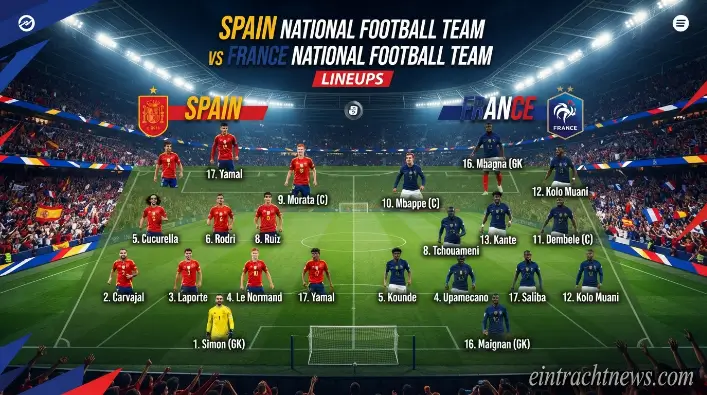
France’s starting lineup brought together defensive structure, midfield strength, and attacking pace. Mike Maignan started between the posts, with Jules Koundé, Dayot Upamecano, William Saliba, and Lucas Digne making up the back four. In midfield, Adrien Rabiot and Aurélien Tchouaméni provided stability while helping France move the ball from defense into the attacking areas.
In the forward positions, Ousmane Dembélé, Michael Olise, and Bradley Barcola played behind Kylian Mbappé. Their pace, movement, and individual ability gave France different attacking options and helped the team create space and opportunities when moving forward.
France Starting XI and Player Positions
| Position | Player | Role |
| GK | Mike Maignan | Goalkeeper |
| RB | Jules Koundé | Right-back |
| CB | Dayot Upamecano | Centre-back |
| CB | William Saliba | Centre-back |
| LB | Lucas Digne | Left-back |
| CM | Adrien Rabiot | Central midfielder |
| CM | Aurélien Tchouaméni | Central midfielder |
| RW | Ousmane Dembélé | Right winger |
| AM | Michael Olise | Attacking midfielder |
| LW | Bradley Barcola | Left winger |
| ST | Kylian Mbappé | Striker |
France Formation and Tactical Setup
France used a 4-2-3-1 formation, with Adrien Rabiot and Aurélien Tchouaméni playing deeper in midfield to offer defensive protection and connect the defense with the attacking players. Michael Olise operated centrally behind Kylian Mbappé, while Ousmane Dembélé and Bradley Barcola occupied the wider positions, giving France more width and creating additional attacking options.
Kylian Mbappé remained France’s main attacking outlet, using his pace and movement to challenge Spain’s defensive line. The setup also provided a structure for quick transitions, allowing France to move forward rapidly after winning possession and look for openings in the final third.
Spain vs France Lineups Comparison
The Spain vs France lineups highlighted two contrasting tactical approaches in the semi-final. Spain relied on possession-based football, midfield control, and patient passing to dictate the tempo, while France adopted a more direct style focused on defensive structure, pace, and quick transitions.
These tactical differences were reflected in the formations and responsibilities of key players on both sides. Spain looked to control the ball and build attacks carefully, whereas France aimed to stay organized and use its speed to create opportunities during fast attacking moves.
Spain vs France Formation Comparison
| Area | Spain | France |
| Shape | 4-1-2-3 | 4-2-3-1 |
| Midfield | Rodri behind two midfielders | Rabiot and Tchouaméni as a double pivot |
| Main threat | Yamal and Olmo | Mbappé and Dembélé |
| Style | Possession and passing | Transitions and direct attacks |
Biggest Lineup Differences
Spain’s main tactical advantage came from Rodri’s position just in front of the defense. His presence allowed Fabián Ruiz and Dani Olmo to push forward more freely while helping Spain maintain control through the center of the pitch. On the flanks, Lamine Yamal and Álex Baena provided width, stretching France’s defensive shape and creating more space for Spain’s attacks.
France used a different midfield structure, with Adrien Rabiot and Aurélien Tchouaméni positioned deeper as a defensive pairing. Their roles helped protect the back four while allowing the attacking players greater freedom to move forward. As a result, the tactical battle was about more than simply 4-1-2-3 vs 4-2-3-1; the key difference was how each team organized its midfield to control possession, create space, and develop attacking opportunities.
Key Player Battles in Spain vs France
The Spain vs France lineups created several interesting individual battles across the pitch. Lamine Yamal offered Spain creativity, pace, and width on the flank, while Kylian Mbappé provided France with a constant attacking threat. In the center of the pitch, Rodri had an important role in controlling possession and helping Spain dictate the tempo.
These individual contests could have a significant impact on how both teams created space and developed their attacking moves. Winning the key areas of the pitch could help either side control the rhythm of the match and generate more opportunities in the final third.
Lamine Yamal vs France’s Left Side
Lamine Yamal played an important role as one of Spain’s key wide attackers, using his pace, dribbling, and movement to challenge France’s defensive shape. When he moved into central areas, he could create space for teammates and offer another passing option. Staying wider, meanwhile, helped stretch the French defense and create gaps for Spain to exploit.
France had to stay alert when defending Yamal, applying pressure while limiting the space available to him. Keeping his movement under control was important, as his ability to move between positions could help Spain open up the defense and create promising chances in the attacking third.
Kylian Mbappé vs Spain’s Defense
Mbappé was France’s primary go al threat, especially when the team transitioned quickly after winning the ball back. His explosive pace and intelligent movement allowed him to attack spaces behind Spain’s defensive line and create dangerous opportunities in the final third.
Spain’s defenders needed to stay compact, communicate effectively, and limit the gaps available for Mbappé to exploit. Preventing him from making clean runs behind the defense was an important part of Spain’s defensive strategy and could help reduce France’s attacking threat.
Rodri vs France’s Midfield
Rodri played a key role in Spain’s midfield control, helping the team keep possession, start attacks from deeper areas, and provide protection in front of the defense. His awareness, passing range, and ability to read the game made him an important connection between Spain’s defensive and attacking phases.
France’s midfield had the task of limiting Rodri’s influence and giving him as little time on the ball as possible. Pressuring his passing options could disrupt Spain’s build-up play, make it more difficult for the team to maintain its rhythm, and reduce its ability to control the tempo of the match.
Spain vs France Substitutes and Bench Options
Both teams had several quality options available on the bench during the semi-final. Spain could call on experienced players such as Pedri, Ferran Torres, Nico Williams, Mikel Merino, and Mikel Zubimendi, giving the manager different ways to adjust the team as the match progressed.
France also had a strong selection of substitutes, with players including Désiré Doué, N’Golo Kanté, Rayan Cherki, Ibrahima Konaté, and Marcus Thuram available to make an impact. Their presence offered France additional creativity, defensive cover, and attacking pace, providing more tactical flexibility throughout the game.
Spain Substitutes
Spain’s bench offered useful alternatives in midfield and attack, giving the team extra creativity, pace, and energy. Players such as Pedri and Nico Williams could change the tempo when introduced, providing fresh movement and new attacking ideas as the match progressed.
France Substitutes
France’s substitutes gave the team several options to increase attacking intensity or add more defensive stability as the match progressed. Players such as Désiré Doué, Rayan Cherki, and Marcus Thuram could provide fresh energy, creativity, and movement when introduced.
What the Lineups Tell Us About the Match
The Spain vs France lineups showcased two distinct tactical approaches, with both teams using different formations and playing styles to create chances and influence the flow of the match. Spain focused on possession, quick passing, and movement to control the game, while France looked to use pace, direct attacking play, and quick transitions to threaten the opposition.
Spain’s Approach
Spain aimed to control possession and use its midfield to dictate the tempo of the game. Rodri provided defensive protection in front of the back line, allowing Fabián Ruiz and Dani Olmo to move into more advanced positions and support the attack. This structure helped Spain maintain control in central areas while creating passing options during build-up play.
France’s Approach
France adopted a more direct tactical approach, with the double pivot of Adrien Rabiot and Aurélien Tchouaméni providing protection in front of the defense and helping the team transition quickly into attack. Their positioning also allowed France to maintain balance while supporting the forward players.
Why the Tactical Battle Mattered
Spain’s midfield structure played an important role in controlling key phases of the match. Rodri helped provide balance in front of the defense, while Fabián Ruiz and Dani Olmo contributed to Spain’s passing game and attacking build-up. Despite France having several dangerous attacking players, Spain’s organized shape made it harder for them to turn their possession and movement into clear chances.
The final result also reflected Spain’s ability to execute its approach effectively and capitalize on important opportunities.
Spain vs France Match Result and Key Moments
Spain secured a 2-0 victory over France in the 2026 FIFA World Cup semi-final. Mikel Oyarzabal opened the scoring from the penalty spot in the 22nd minute, before Pedro Porro added Spain’s second goal in the 58th minute. Spain remained organized throughout the match, managing its advantage effectively and securing a place in the next stage of the tournament.
France had several talented attacking players and looked for ways to respond, but the team struggled to turn its attacking moves into clear scoring opportunities. Spain’s defensive organization and efficient finishing ultimately helped them protect their lead. For complete match details, including the confirmed starting lineups and substitutes, readers can refer to the official Spain vs France team sheets.
Frequently Asked Questions
When did Spain and France last meet in the World Cup?
Spain and France faced each other in the 2026 FIFA World Cup semi-final on July 14, 2026, in Dallas.
Who managed Spain and France in the match?
Spain was managed by Luis de la Fuente, while France was coached by Didier Deschamps during the tournament.
Which team had more attacking options?
Both teams had strong attacking players, but Spain’s combination of wide players and creative midfielders gave it several ways to create chances.
Why was Spain’s midfield important against France?
Spain’s midfield helped the team keep possession, control the tempo, and move the ball into attacking areas without losing its defensive balance.
What made the Spain vs France matchup significant?
The match brought together two of Europe’s strongest national teams and featured a tactical contest between Spain’s possession-based style and France’s quick attacking transitions.
Conclusion
The Spain national football team vs France national football team lineups reflected two contrasting styles of play in the semi-final. Spain focused on midfield control, quick passing, and creating opportunities through the wide areas. Rodri provided balance in the center of the pitch, while Dani Olmo and Lamine Yamal contributed creativity, movement, and attacking options. France also had significant attacking quality, with Kylian Mbappé leading the attack and players such as Ousmane Dembélé and Michael Olise providing additional options in the final third.
Spain’s organized approach played an important role in the match, as the team maintained its structure and used possession to build attacks. France created attacking moments but found it difficult to consistently exploit spaces in Spain’s defensive setup. The 2-0 result came after Spain converted its key opportunities and managed the game effectively, making the lineup choices and tactical execution important factors in the semi-final.
