

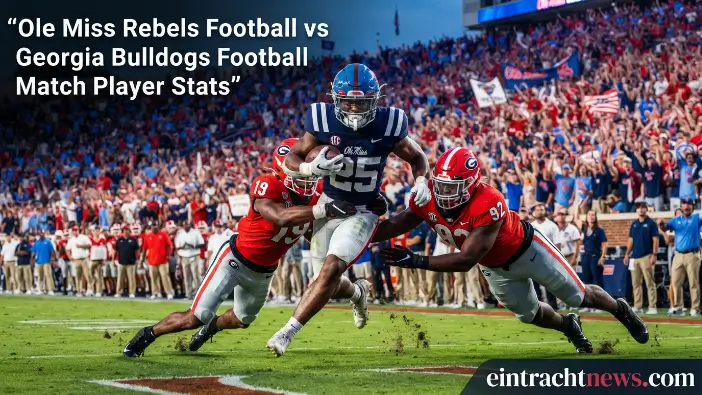
Welcome to Eintracht News. The Ole Miss Rebels vs. Georgia Bulldogs player stats from the 2025–26 College Football Playoff showcase a thrilling contest that ended with Ole Miss earning a dramatic 39–34 victory over Georgia in the Sugar Bowl on January 1, 2026, at Caesars Superdome in New Orleans. The Rebels produced an impressive fourth-quarter comeback, scoring 20 points in the final period to turn the game in their favor.
The matchup featured several notable individual performances from both teams, with quarterbacks, running backs, and wide receivers making important contributions throughout the game. Ole Miss quarterback Trinidad Chambliss led the Rebels’ passing attack with 362 passing yards and two touchdowns, while wide receiver Harrison Wallace III provided a major threat in the receiving game, finishing with nine receptions for 156 yards and one touchdown.
Ole Miss Rebels vs Georgia Bulldogs Match Overview
The Ole Miss Rebels vs. Georgia Bulldogs football match player stats reflect how competitive the College Football Playoff quarterfinal was from start to finish. The Sugar Bowl took place on January 1, 2026, at Caesars Superdome in New Orleans, with Ole Miss defeating Georgia 39–34 in a dramatic finish.
Ole Miss opened the game with a 6–0 lead in the first quarter, but Georgia responded strongly in the second period, scoring 21 points to take control of the contest. After halftime, the Rebels began to regain momentum and produced their biggest offensive push in the fourth quarter. Ole Miss scored 20 points in the final period, completing a comeback and securing the five-point victory.
Final Score and Game Information
Ole Miss secured a 39–34 victory over Georgia in the Sugar Bowl, advancing from the College Football Playoff quarterfinal. The matchup was played on January 1, 2026, at Caesars Superdome, with Ole Miss improving to 13–1 and Georgia falling to 12–2.
The final score reflected a game filled with momentum swings. Georgia built a strong advantage with a big second quarter, but Ole Miss responded after halftime and delivered a decisive comeback in the second half to claim the win.
| Detail | Ole Miss | Georgia |
| Final Score | 39 | 34 |
| Date | January 1, 2026 | January 1, 2026 |
| Venue | Caesars Superdome | Caesars Superdome |
| Competition | Sugar Bowl / CFP Quarterfinal | Sugar Bowl / CFP Quarterfinal |
| Record After Game | 13-1 | 12-2 |
Ole Miss’ fourth-quarter surge proved to be the turning point of the game. The Rebels scored 20 points in the final quarter, transforming a closely contested matchup into a five-point victory. Their strong finish capped one of the most significant late-game comebacks of the season.
Team Statistical Comparison
The team statistical comparison between the Ole Miss Rebels and Georgia Bulldogs shows how both teams found different ways to move the football during the College Football Playoff matchup. Ole Miss generated 473 total yards, including 362 passing yards, giving the Rebels a clear advantage through the air. Georgia finished with 343 total -yards, with 219 passing yards.
Georgia was more productive on the ground, recording 124 rushing yards compared with Ole Miss’ 111 rushing yards. The Bulldogs also held the ball longer, controlling possession for 32:32, while Ole Miss had the football for 27:28.
| Team Stat | Ole Miss | Georgia |
| Total Yards | 473 | 343 |
| Passing Yards | 362 | 219 |
| Rushing Yards | 111 | 124 |
| First Downs | 23 | 23 |
| Third Down | 5-of-14 | 3-of-13 |
| Fourth Down | 1-of-2 | 2-of-3 |
| Turnovers Lost | 1 | 1 |
| Time of Possession | 27:28 | 32:32 |
The biggest statistical difference between the two teams came in the passing game. Ole Miss finished with 143 more passing yards than Georgia and also recorded a 130-yard advantage in total offense. While Georgia produced more rushing yards and controlled possession for a longer period, the Bulldogs were unable to match Ole Miss’ passing production.
In the end, offensive efficiency and strong late-game execution played an important role in the result. Ole Miss made the most of its opportunities and held on to secure a 39–34 victory over Georgia in the Sugar Bowl.
Read Also: Indiana Hoosiers football vs Ohio State Buckeyes football match player stats
Ole Miss Rebels Player Stats
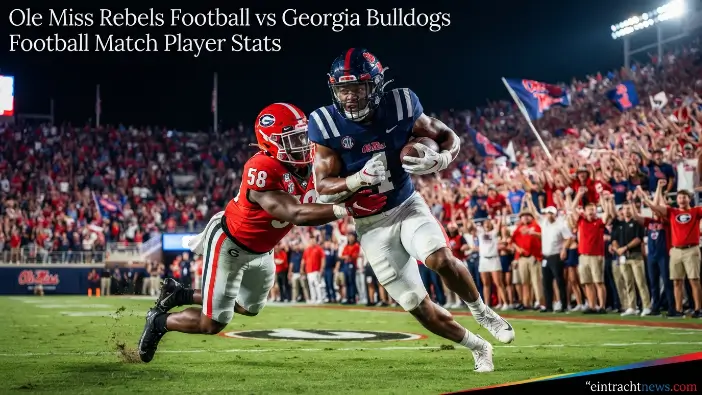
The Ole Miss Rebels player stats showcase several strong individual performances from the team’s 39–34 Sugar Bowl victory over Georgia. Quarterback Trinidad Chambliss led the Rebels’ passing attack with 362 passing yards and two touchdowns, helping Ole Miss maintain its offensive momentum throughout the game. Running back Kewan Lacy also made a major contribution, finishing with 98 rushing yards and two touchdowns.
In the passing game, wide receiver Harrison Wallace III was one of Ole Miss’ standout performers, recording 156 receiving yards and one touchdown. Kicker Lucas Carneiro added valuable points as well, successfully converting three field-goal attempts during the contest.
Ole Miss Passing Stats
Trinidad Chambliss led the Ole Miss passing stats, completing 30 of 46 pass attempts for 362 yards and two touchdowns without throwing an interception. His longest completion went for 44 yards, helping the Rebels maintain a productive passing attack against Georgia throughout the game.
Chambliss’ performance was a major part of Ole Miss’ offensive production. The Rebels finished with a significant advantage in passing yards over the Bulldogs, giving them more opportunities to move the ball downfield and create scoring chances. His accuracy, yardage production, and ability to avoid turnovers helped Ole Miss build offensive momentum and secure the 39–34 Sugar Bowl victory.
| Player | C/ATT | Pass Yards | TD | INT | Long |
| Trinidad Chambliss | 30/46 | 362 | 2 | 0 | 44 |
His late-game passing played a key role in the Rebels’ offensive surge, helping Ole Miss respond after Georgia had controlled much of the game earlier and setting the stage for the comeback victory.
Ole Miss Rushing Stats
Kewan Lacy led the Ole Miss rushing stats, finishing the game with 98 rushing yards and two touchdowns on 22 carries. He averaged 4.5 yards per carry and recorded a longest run of 16 yards, making him the Rebels’ leading rusher in the matchup.
Lacy provided consistent production on the ground throughout the contest, giving Ole Miss an effective running option alongside its strong passing attack. His ability to gain steady yardage and find the end zone helped the Rebels maintain offensive balance and keep pressure on Georgia’s defense during the 39–34 Sugar Bowl victory.
| Player | Carries | Rushing Yards | TD | Avg. |
| Kewan Lacy | 22 | 98 | 2 | 4.5 |
| Trinidad Chambliss | 4 | 14 | 0 | 3.5 |
| Deuce Alexander | 1 | -1 | 0 | -1.0 |
Lacy scored two touchdowns in the second half, including a crucial 5-yard rushing touchdown in the fourth quarter that put Ole Miss ahead 27–24. His strong red-zone production helped the Rebels convert important drives into points and played a key role in their second-half comeback.
His ability to finish drives with timely runs gave Ole Miss valuable momentum as the Rebels pushed toward their eventual 39–34 victory.
Ole Miss Receiving Stats
Harrison Wallace III led the Ole Miss receiving stats, finishing with nine receptions for 156 yards and one touchdown. His longest catch went for 44 yards, making him the Rebels’ leading wide receiver and one of quarterback Trinidad Chambliss’ most reliable targets.
Wallace consistently created big-play opportunities, using his ability to gain significant yardage and make key downfield catches to give Ole Miss a major advantage through the air.
| Player | Receptions | Receiving Yards | TD | Long |
| Harrison Wallace III | 9 | 156 | 1 | 44 |
| De’Zhaun Stribling | 7 | 122 | 0 | 40 |
| Cayden Lee | 4 | 19 | 0 | 12 |
| Dae’Quan Wright | 2 | 18 | 0 | 0 |
De’Zhaun Stribling also delivered a strong performance, finishing with 122 receiving yards and a 40-yard catch. His big reception during the final drive helped put Ole Miss in a strong position for the game-winning field goal.
Ole Miss Defensive and Special Teams Stats
The Ole Miss defensive stats were led by Zxavian Harris, who recorded 10 tackles. Suntarine Perkins also delivered a strong defensive performance with six tackles, two tackles for loss, one sack, one forced fumble, and one fumble recovery. Meanwhile, Will Echoles contributed five tackles, two tackles for loss, and two pass breakups. These defensive efforts helped the Rebels generate pressure and make important stops whenever Georgia threatened to take control of the game.
On special teams, Lucas Carneiro made a major impact by converting all three of his field-goal attempts. He successfully connected from 55, 56, and 47 yards, with his 47-yard kick coming with just six seconds remaining to give Ole Miss a 37–34 lead. His perfect kicking performance proved to be one of the key factors in the Rebels’ dramatic 39–34 victory.
Georgia Bulldogs Player Stats
The Georgia Bulldogs player stats show a solid overall performance in the team’s 39–34 loss to Ole Miss in the Sugar Bowl. Georgia recorded 343 total yards, including 219 passing yards and 124 rushing yards, as the Bulldogs combined their passing and ground attacks to stay competitive throughout the game.
Quarterback Gunner Stockton contributed in both the passing and rushing phases, while running back Nate Frazier led Georgia’s ground game with a strong individual performance. Wide receiver Zachariah Branch emerged as the Bulldogs’ leading receiver, giving the offense an important option through the air.
Georgia Passing Stats
Gunner Stockton led the Georgia passing stats, completing 18 of 31 pass attempts for 203 yards and one touchdown without throwing an interception. He was sacked twice during the game, while Landon Roldan completed his only pass attempt for 16 yards.
Stockton’s passing numbers were lower than those of Ole Miss quarterback Trinidad Chambliss, but he contributed in multiple areas of Georgia’s offense. His ability to make plays both through the air and on the ground gave the Bulldogs an additional offensive option and helped them move the ball consistently.
| Player | C/ATT | Pass Yards | TD | INT | Long |
| Gunner Stockton | 18/31 | 203 | 1 | 0 | 31 |
| Landon Roldan | 1/1 | 16 | 0 | 0 | 16 |
His dual-threat performance gave Georgia another dimension offensively and helped keep the matchup close deep into the game.
Georgia Rushing Stats
Nate Frazier led the Georgia rushing stats, finishing with 86 rushing yards on 15 carries while averaging 5.7 yards per attempt. His consistent production made him the Bulldogs’ leading rusher and accounted for a significant share of Georgia’s ground-game output.
As a team, Georgia recorded 124 rushing yards, giving the Bulldogs a 13-yard advantage over Ole Miss in the rushing category. Frazier’s steady running helped Georgia maintain an effective ground attack and provided an important balance to the team’s passing game throughout the matchup.
| Player | Carries | Rushing Yards | TD | Avg. |
| Nate Frazier | 15 | 86 | 0 | 5.7 |
| Gunner Stockton | 13 | 20 | 2 | 1.5 |
| Chauncey Bowens | 5 | 10 | 0 | 2.0 |
| Cash Jones | 2 | 11 | 0 | 5.5 |
Georgia’s success on the ground kept the game competitive, but Ole Miss’ ability to generate more yardage through the air ultimately proved decisive in the 39–34 result.
Georgia Receiving Stats
Zachariah Branch led the Georgia receiving stats, finishing with eight receptions for 67 yards and one touchdown. His 18-yard touchdown reception from Gunner Stockton came with 7:03 remaining in the fourth quarter, bringing Georgia within three points of Ole Miss.
Branch’s performance made him the Bulldogs’ leading receiver and gave Georgia an important scoring opportunity late in the game. His touchdown kept the Bulldogs within striking distance and added to the intensity of the final quarter as both teams battled during the decisive closing stages.
| Player | Receptions | Receiving Yards | TD | Long |
| Zachariah Branch | 8 | 67 | 1 | 18 |
| Cash Jones | 2 | 45 | 0 | 26 |
| Nate Frazier | 3 | 42 | 0 | 24 |
| Colbie Young | 3 | 22 | 0 | 31 |
| Lawson Luckie | 1 | 20 | 0 | 16 |
That gap in the passing game was one of the clearest statistical advantages for the Rebels and played an important role in Ole Miss’ ability to secure the 39–34 victory.
Georgia Defensive and Special Teams Stats
KJ Bolden led the Georgia defensive stats with 10 total tackles, while Daylen Everette added nine tackles. Everette also delivered a major defensive play by returning a fumble 47 yards for a touchdown in the second quarter. The defensive score helped Georgia build momentum and contributed to its strong 21-point second quarter.
On special teams, Peyton Woodring converted field-goal attempts from 37 and 24 yards, but missed a 55-yard attempt, finishing 2-of-3 on field goals. Ole Miss was perfect on all three of its attempts. The difference in special teams execution became particularly important late in the game, as the Rebels converted a decisive 47-yard field goal with six seconds remaining to take the lead and secure the victory.
Top Player Performances From Ole Miss vs Georgia
KJ Bolden led the Georgia defensive stats with 10 total tackles, while Daylen Everette added nine tackles. Everette also delivered a major defensive play by returning a fumble 47 yards for a touchdown in the second quarter. The defensive score helped Georgia build momentum and contributed to its strong 21-point second quarter.
On special teams, Peyton Woodring converted field-goal attempts from 37 and 24 yards, but missed a 55-yard attempt, finishing 2-of-3 on field goals. Ole Miss was perfect on all three of its attempts. The difference in special teams execution became particularly important late in the game, as the Rebels converted a decisive 47-yard field goal with six seconds remaining to take the lead and secure the victory.
Ole Miss Standout Players
Trinidad Chambliss was Ole Miss’ standout offensive performer, throwing for 362 yards and two touchdowns. His passing total was 159 yards higher than Gunner Stockton’s 203 yards, giving the Rebels a notable advantage through the air. Kewan Lacy was Ole Miss’ leading contributor on the ground, rushing for 98 yards and two touchdowns on 22 carries. His two rushing scores provided valuable points as the Rebels built momentum during the second half.
Harrison Wallace III was Ole Miss’ leading receiving threat, finishing with nine receptions for 156 yards and one touchdown. His ability to produce significant gains through the air helped the Rebels sustain their passing attack and consistently challenge Georgia’s defense.
Key Ole Miss Performers
- Trinidad Chambliss: Delivered an outstanding passing performance with 362 passing yards and 2 passing touchdowns, helping Ole Miss control the game through the air.
- Kewan Lacy: Made a major impact on the ground, finishing with 98 rushing yards and 2 rushing touchdowns while providing important scoring plays for the Rebels.
- Harrison Wallace III: Led the receiving group with 156 receiving yards and 1 receiving touchdown, making several key catches throughout the game.
- Lucas Carneiro: Came through with a 47-yard game-changing field goal, providing a crucial late score during Ole Miss’ comeback victory.
Georgia Standout Players
Gunner Stockton was one of Georgia’s main offensive contributors, completing his performance with 203 passing yards and one passing touchdown while also adding two rushing touchdowns. His ability to contribute as both a passer and runner gave the Bulldogs a valuable dual-threat option and helped keep the offense productive throughout the game.
Nate Frazier led Georgia’s rushing attack with 86 yards on 15 carries, averaging an impressive 5.7 yards per carry. His consistent production on the ground accounted for a significant portion of Georgia’s rushing offense and helped the Bulldogs maintain balance alongside their passing attack.
Key Georgia Performers
- Gunner Stockton: 203 passing yards, 1 passing touchdown, 2 rushing touchdowns
- Nate Frazier: 86 rushing yards
- Zachariah Branch: 67 receiving yards, 1 receiving touchdown
- Daylen Everette: 47-yard fumble-return touchdown
Ole Miss vs Georgia Player Stats Comparison
The Ole Miss vs. Georgia player stats comparison highlights the Rebels’ stronger overall passing performance, even though Georgia finished the game with a slight advantage in team rushing yards. Trinidad Chambliss held the edge over Gunner Stockton in completions, passing attempts, passing yards, and passing touchdowns, while Stockton provided an additional threat as a runner and scored two rushing touchdowns.
In the rushing matchup, Kewan Lacy finished with slightly more yardage than Nate Frazier and also contributed two rushing touchdowns for Ole Miss. The clearest statistical difference came in the receiving game, where Harrison Wallace III produced significantly more yardage than Georgia’s leading receiver, Zachariah Branch.
Quarterback Comparison
Trinidad Chambliss delivered the stronger passing performance, completing 30 of 46 attempts for 362 yards and two touchdowns without throwing an interception. Gunner Stockton completed 18 of 31 passes for 203 yards and one touchdown, while also avoiding an interception.
Chambliss held a clear statistical advantage in both passing volume and overall production. He finished with 159 more passing yards than Stockton and recorded one additional passing touchdown. His higher completion total, greater passing volume, and significantly higher yardage output gave Ole Miss a notable advantage through the air and played an important role in the Rebels’ offensive performance.
| Statistic | Trinidad Chambliss | Gunner Stockton |
| Completions | 30 | 18 |
| Attempts | 46 | 31 |
| Passing Yards | 362 | 203 |
| Passing TDs | 2 | 1 |
| INTs | 0 | 0 |
| Long Pass | 44 | 31 |
| Rushing Yards | 14 | 20 |
| Rushing TDs | 0 | 2 |
Stockton had the greater impact as a runner, finishing with 20 rushing yards and two touchdowns, while Chambliss recorded 14 rushing yards without a rushing score. The contrast between the two quarterbacks was clear: Chambliss provided the bigger threat through the air, while Stockton added valuable scoring production with his legs, particularly near the goal line.
Leading Rusher and Receiver Comparison
Kewan Lacy led the Ole Miss rushing attack with 98 yards and two rushing touchdowns, while Georgia’s Nate Frazier finished with 86 rushing yards and no rushing touchdowns. Although the difference between the two leading rushers was just 12 yards, Lacy made the greater impact on the scoreboard by turning his rushing production into two touchdowns.
Lacy’s ability to capitalize on important opportunities in the running game helped Ole Miss turn its ground production into points. His two rushing scores provided valuable contributions during the game and played an important role in the Rebels’ comeback victory over Georgia.
| Category | Ole Miss | Georgia |
| Leading rusher | Kewan Lacy | Nate Frazier |
| Rushing yards | 98 | 86 |
| Rushing TDs | 2 | 0 |
| Leading receiver | Harrison Wallace III | Zachariah Branch |
| Receiving yards | 156 | 67 |
| Receiving TDs | 1 | 1 |
The biggest statistical difference came in the receiving game. Harrison Wallace III finished with 156 receiving yards, more than twice Zachariah Branch’s 67 yards, although both players recorded one touchdown.
How the Player Stats Shaped the 39–34 Result
The Ole Miss vs. Georgia player stats were an important part of the 39–34 result, with the Rebels holding their biggest statistical advantage in the passing game and overall offensive production. Ole Miss finished with 362 passing yards and 473 total yards, compared with Georgia’s 219 passing yards and 343 total yards. The significant difference in passing production helped the Rebels create more offensive opportunities throughout the game.
Georgia’s rushing attack remained effective and kept the Bulldogs competitive, but Ole Miss generated more total offense and made several important plays during the later stages of the matchup. The Rebels’ stronger passing performance, combined with their ability to execute key plays in the fourth quarter, helped them overcome Georgia’s lead and secure the 39–34 victory.
Ole Miss’ Passing and Receiving Production
Ole Miss’ 362 passing yards were the biggest offensive statistical advantage in the matchup. Quarterback Trinidad Chambliss consistently connected with Harrison Wallace III and De’Zhaun Stribling, who combined for 278 receiving yards. Wallace led the Rebels with 156 yards, while Stribling contributed another 122 yards, giving Ole Miss two dependable receiving threats throughout the game.
Their combined production helped the Rebels finish with 473 total yards, which was 130 more than Georgia’s 343 total yards. Chambliss’ ability to consistently find his receivers created several explosive plays and placed continued pressure on the Bulldogs’ defense. The effectiveness of Ole Miss’ passing attack was a major part of its offensive success and helped the Rebels produce the plays needed during the decisive stages of the game.
Georgia’s Rushing and Quarterback Contributions
Georgia’s 124 rushing yards gave the Bulldogs a slight edge over Ole Miss in the ground game. Nate Frazier led the team with 86 rushing yards, while quarterback Gunner Stockton added 20 yards and two rushing touchdowns. Georgia’s effective ground game helped keep the Bulldogs competitive and provided an important source of scoring when their passing attack struggled to produce at the same level as Ole Miss.
Stockton’s two rushing touchdowns were especially valuable, but Georgia finished with just 219 passing yards compared with Ole Miss’ 362 yards through the air. That difference limited the Bulldogs’ overall offensive production. While Georgia’s rushing success helped keep the contest close, the lack of comparable passing production made it difficult to match Ole Miss’ offense during the decisive stages of the game.
The Fourth-Quarter Difference
The fourth quarter became the turning point of the game, with Ole Miss scoring 20 points during the final period. Kewan Lacy found the end zone twice, while Harrison Wallace III added a 13-yard touchdown reception as the Rebels built a 34–24 lead. These key scoring plays allowed Ole Miss to turn its offensive production into points and take control during the crucial closing stages.
Georgia refused to go away and managed to tie the game 34–34 with 56 seconds remaining, setting up a dramatic finish. Ole Miss kicker Lucas Carneiro then delivered the decisive play, converting a 47-yard field goal with six seconds left to put the Rebels back in front. A safety on the final kickoff added the final points, sealing the 39–34 victory for Ole Miss.
Ole Miss vs Georgia 2025 Regular-Season Meeting vs Sugar Bowl
Trinidad Chambliss delivered the stronger passing performance, completing 30 of 46 attempts for 362 yards and two touchdowns without throwing an interception. Georgia quarterback Gunner Stockton completed 18 of 31 passes for 203 yards and one touchdown, also finishing the game without an interception.
Chambliss held a clear statistical advantage in both passing volume and production. He finished with 159 more passing yards and one additional passing touchdown than Stockton, while also recording more completions and attempts. His ability to consistently move the ball through the air gave Ole Miss a significant passing advantage and contributed to the Rebels’ offensive success in the 39–34 victory.
Regular-Season Meeting
The teams first met on October 18, 2025, at Sanford Stadium in Athens, where Georgia earned a 43–35 victory over Ole Miss. Gunner Stockton passed for 289 yards, while Trinidad Chambliss finished with 263 passing yards for the Rebels. Georgia also established a significant advantage on the ground, rushing for 221 yards compared with just 88 rushing yards by Ole Miss.
The regular-season meeting featured a different offensive balance from the teams’ later Sugar Bowl rematch. Georgia’s effective rushing attack played an important role in controlling the game and helping the Bulldogs build an eight-point advantage. The 43–35 result gave Georgia the edge in the regular-season matchup, before Ole Miss responded with a comeback victory in the postseason Sugar Bowl.
Sugar Bowl Rematch
The Sugar Bowl rematch featured a noticeable shift in offensive production, with Ole Miss recording 362 passing yards and 473 total yards during its 39–34 victory. Georgia finished with 343 total yards, but the Rebels overcame a nine-point halftime deficit to complete a dramatic comeback and secure the postseason win.
The contrast between the two meetings was clear. Georgia’s rushing dominance was a major factor in its regular-season victory, while Ole Miss relied more heavily on its passing attack and overall offensive production in the Sugar Bowl. The Rebels’ ability to generate yardage through the air and execute important plays late in the game helped them overcome Georgia and earn the rematch victory.
| Game | Winner | Final Score |
| Regular Season | Georgia | 43-35 |
| Sugar Bowl | Ole Miss | 39-34 |
The postseason victory not only evened the season series between the two teams but also gave the Rebels an important College Football Playoff win and secured their place in the national semifinal.
Key Takeaways From the Ole Miss vs Georgia Player Stats
The Ole Miss vs. Georgia player stats highlight several individual performances that shaped the Rebels’ 39–34 Sugar Bowl victory. Trinidad Chambliss led all passers with 362 passing yards and two touchdowns, while Kewan Lacy made a major contribution on the ground with 98 rushing yards and two rushing touchdowns. At wide receiver, Harrison Wallace III led the game with 156 receiving yards and one touchdown, providing Chambliss with a reliable target throughout the matchup.
For Georgia, Nate Frazier led the Bulldogs’ rushing attack with 86 yards, while Zachariah Branch finished with 67 receiving yards and one touchdown. Despite Georgia’s effective rushing production, Ole Miss held a substantial advantage through the air, recording 362 passing yards compared with Georgia’s 219 yards. That difference helped the Rebels generate more overall offensive production during the comeback.
FAQ About Ole Miss Rebels vs Georgia Bulldogs Football Match Player Stats
Who won the Ole Miss vs Georgia football game on January 1, 2026?
Ole Miss defeated Georgia 39-34 in the Allstate Sugar Bowl and advanced to the College Football Playoff semifinals.
Who was the leading passer in the Ole Miss vs Georgia Sugar Bowl?
Ole Miss quarterback Trinidad Chambliss led the game with 362 passing yards and two touchdowns on 30-of-46 passing.
Who led Ole Miss in rushing against Georgia?
Kewan Lacy led Ole Miss with 98 rushing yards and two touchdowns on 22 carries.
Who had the most receiving yards for Ole Miss?
Harrison Wallace III led the Rebels with nine receptions for 156 yards and one touchdown.
Did Ole Miss and Georgia play twice in the 2025 season?
Yes. Georgia won the October 18 regular-season meeting 43-35. Ole Miss then won the January 1 Sugar Bowl rematch 39-34.
Conclusion
The Ole Miss vs. Georgia player stats show that the Rebels’ victory was built on stronger passing production, timely rushing touchdowns, and effective execution during crucial moments. Trinidad Chambliss led the passing attack with 362 yards and two touchdowns, while Harrison Wallace III added 156 receiving yards and one touchdown. Kewan Lacy also made a significant contribution on the ground, finishing with 98 rushing yards and two touchdowns. Together, these performances provided Ole Miss with the offensive balance needed to overcome Georgia’s early advantage and complete the comeback.
Georgia also received important contributions from several key players. Gunner Stockton finished with 203 passing yards and three total touchdowns, combining his passing and rushing production to give the Bulldogs a dual-threat presence. Nate Frazier led Georgia’s rushing attack with 86 yards, while Zachariah Branch contributed 67 receiving yards and one touchdown, helping the Bulldogs remain competitive and within striking distance late in the game.
