

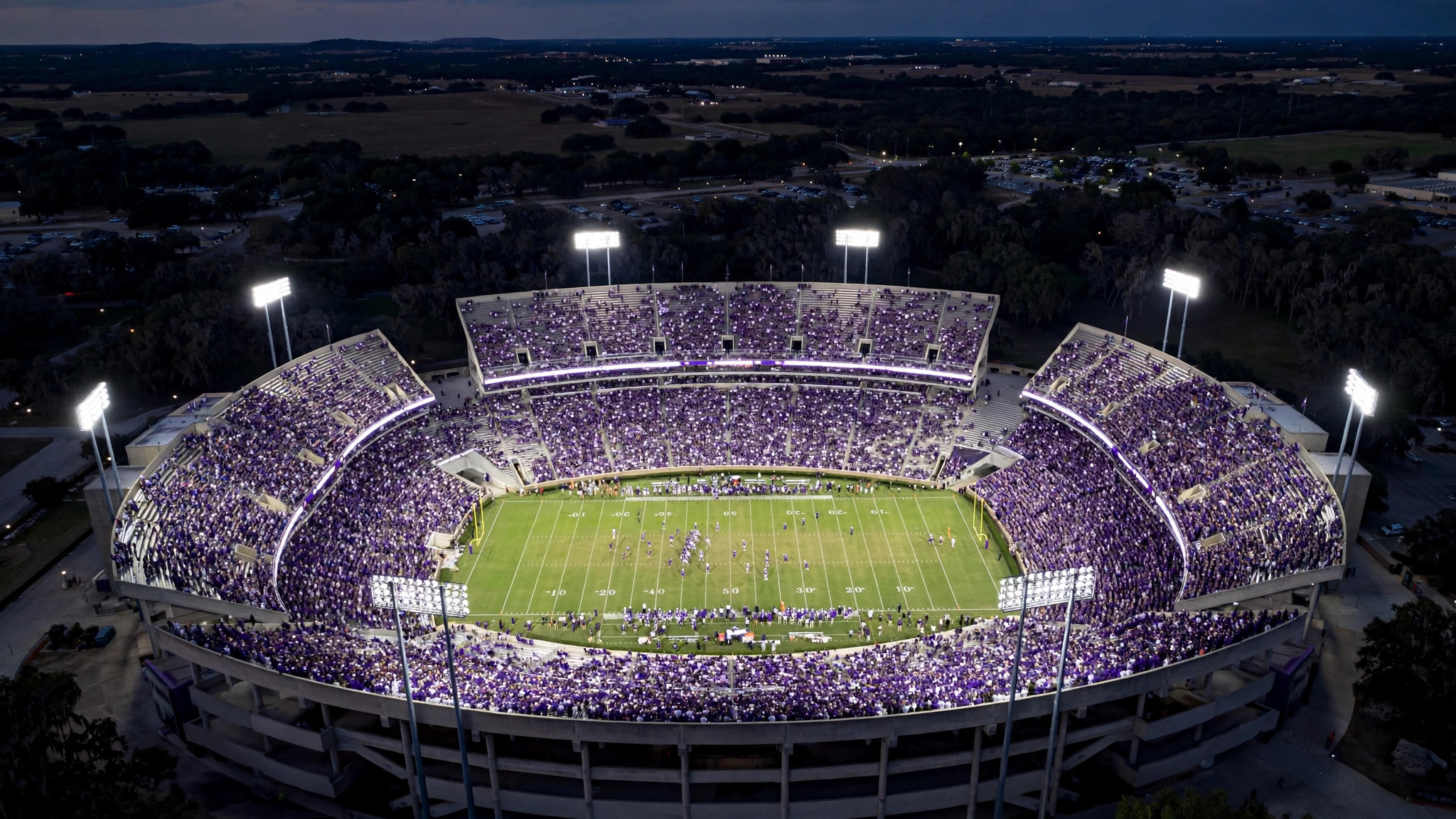
There is no nickname in college football quite like the Horned Frogs, and there is no program quite like TCU either. Tucked into Fort Worth, Texas, TCU football has spent more than a century punching above its weight — a private school with a modest enrollment that keeps finding its way into the biggest conversations in the sport.
This guide covers everything a new fan needs: where the Horned Frogs play, the championships in the trophy case, the remarkable run to a national title game, and the traditions that make a Saturday in Fort Worth feel different from anywhere else in Texas. If tcu football has ever caught your eye from the outside, this is your way in.
TCU Football at a Glance
TCU — Texas Christian University — fields its team in Fort Worth, where the Horned Frogs have played since the program’s earliest days. The colors are purple and white, the mascot is SuperFrog, and the attitude has always been a little bit chip-on-the-shoulder. TCU is not the biggest school in Texas, and its fans would not have it any other way.
Today the program competes in the Big 12 Conference, one of the sport’s power leagues, after a long and winding journey through several conferences. That journey is a big part of the tcu football identity: few programs have climbed as many ladders, or been told as often that the next rung was out of reach.
Here are the basics every fan should know:
- Home: Amon G. Carter Stadium in Fort Worth, holding about 46,000 fans
- Conference: Big 12
- Colors: purple and white
- Mascot: SuperFrog, one of the most recognizable in the country
- National championships: 1935 and 1938
A History Built on Climbing
The early chapters of tcu football are genuinely golden. The Horned Frogs claimed national championships in 1935 and 1938, back when Fort Worth was a genuine center of the college football world and TCU stars were household names across the country. Those teams established a standard the program has chased ever since.
Then came the long middle. Like many programs, TCU endured lean decades, conference shuffling, and seasons where simply reaching a bowl game felt like a triumph. When the old Southwest Conference dissolved, the Frogs were left to wander through a series of leagues, winning as they went and building a reputation as the program nobody wanted to schedule.
That wandering turned out to be a gift. TCU learned to win everywhere, in every time zone, against every style. By the time the Big 12 invitation finally arrived, tcu football was not a charity case knocking on the door — it was a proven winner the league was glad to have, and the Frogs have worked ever since to prove the invitation right.
The Playoff Run Nobody Saw Coming
Every modern fan knows where the story peaks. In the 2022 season, TCU rode a season of wild comebacks and fearless play all the way to the College Football Playoff, then won its semifinal to reach the national championship game. A program once left out of the power structure entirely played for the whole thing.
The title game itself ended in disappointment, but the run changed tcu football forever. It proved the ceiling in Fort Worth is not a good bowl or a top-ten finish — it is the final Monday night of the season. Recruits noticed. Fans noticed. The entire sport noticed.
What made the run so beloved was the style. The Frogs played loose, fast, and completely unafraid, winning close games so often that fans started treating fourth-quarter drama as just another Saturday tradition. Underdogs are not supposed to look that comfortable on the biggest stage, and the comfort is what people remember.
Life in the Big 12
Big 12 football is wide-open, high-scoring, and gloriously unpredictable, and TCU fits it perfectly. The league stretches across the country now, which means tcu football game weeks can bring anyone from old Texas rivals to brand-new opponents the Frogs have rarely faced.
For fans, the Big 12 offers a few guarantees. Expect points. Expect at least one storm-the-field upset somewhere in the league every month. And expect Fort Worth to matter in November, because the Frogs’ blend of Texas recruiting and veteran coaching usually keeps them in the race longer than preseason polls predicted.
Following the league is half the fun. Programs like those in our App State football guide and our USF football guide show how ambitious schools outside the traditional blue bloods can crash big conversations — a story TCU fans know better than almost anyone.
Amon G. Carter Stadium: Small, Loud, and Proud
TCU plays at Amon G. Carter Stadium, a classic bowl on campus that holds about 46,000 fans — intimate by Texas standards, and all the better for it. There is not a bad seat in the house, the purple in the stands pops under the lights, and a full house generates a noise level that routinely surprises visiting fans expecting a quiet afternoon.
The stadium experience leans into its setting. Fort Worth calls itself the place where the West begins, and game day carries a relaxed Texas warmth: boots next to sneakers, brisket smoke drifting over tailgates, and a campus that feels like a neighborhood rather than a concrete sports complex.
If you go, arrive early enough to wander. Watch the band, find SuperFrog working the crowd, and give yourself time to appreciate a venue that proves atmosphere has very little to do with raw capacity. Plenty of 100,000-seat stadiums would trade noise-per-fan with this place without blinking.
Traditions That Make TCU Football TCU
Start with the name itself. The horned frog — actually a small Texas lizard — has been the school’s symbol for well over a century, and TCU fans wear its weirdness as a badge of honor. SuperFrog, the costumed mascot, is a genuine celebrity in Fort Worth, and the “Fear the Frog” spirit runs through every corner of game day.
Then there is the Riff Ram cheer, one of the oldest in college football, a rhythmic chant that generations of students have passed down. Hearing thousands of fans deliver it in unison is the moment visiting fans usually realize this quirky little program has very deep roots.
Game day in Fort Worth tends to include:
- The Riff Ram cheer echoing around the stadium before kickoff
- SuperFrog appearances from tailgates to the student section
- A sea of purple that makes TCU home games instantly recognizable on TV
- Tailgating with a distinctly Fort Worth, laid-back Texas flavor
How the Roster Is Built
TCU recruits in the most contested territory in America. Texas produces more college football talent than almost anywhere, and tcu football shops in the same aisles as Texas, Texas A&M, Oklahoma, and the entire SEC. The Frogs rarely win by outspending everyone; they win by evaluating well and developing players others undervalued.
That approach has a long track record in Fort Worth. TCU became famous for turning overlooked recruits — a quarterback here, a converted athlete there — into all-conference performers through patience and coaching. The transfer portal has added a second pipeline, letting the staff patch immediate needs with experienced players.
For fans tracking the roster, the official depth chart published during the season is the only version worth trusting, and the school’s site updates it as injuries and position battles sort themselves out. August hype is fun, but September’s depth chart is where the truth lives.
How to Follow the Horned Frogs All Season
Keeping up with tcu football is easy if you build the right routine. The official athletics site, GoFrogs.com, is the home for schedules, roster updates, ticket information, and postgame recaps, and it should be the first bookmark any new fan makes.
Big 12 games rotate across a handful of national TV and streaming partners, so checking the schedule page early each week for kickoff times and channels saves the usual Saturday scramble. A good live-score app covers you when you are away from a screen, and our explainer on how long a football game lasts helps you plan the rest of your Saturday around kickoff.
Radio remains a fine Fort Worth tradition too. There is something about hearing a familiar local broadcast team call a fourth-quarter drive that no national feed quite replaces, especially for fans who grew up listening long before streaming existed.
A Game Day in Fort Worth, Step by Step
First-time visitors often ask what a Saturday actually feels like, so here is the honest rhythm of it. The morning belongs to the tailgates, where purple canopies spread across the lots around the stadium and the cooking starts early. Fort Worth takes its food seriously, and a TCU tailgate is as good a place as any in Texas to eat well before noon.
By early afternoon the campus fills in. Students drift toward the stadium, the band’s warm-up notes carry across the lots, and SuperFrog starts making rounds for photos. Inside the gates, the wise move is to be in your seat for the pregame sequence — the Riff Ram, the team entrance, and that first roar when a big game finally gets close enough to touch.
After the game, win or lose, the evening belongs to Fort Worth itself. The stadium sits minutes from neighborhoods full of restaurants and live music, which is why so many visiting fans turn a TCU trip into a full weekend. Few college towns hide inside a real city this comfortably, and fewer still make the combination feel this easy.
Why TCU Keeps Mattering Nationally
It would be simple for a school of TCU’s size to settle into a comfortable regional role. The Frogs have never been interested. Every era of tcu football seems to produce a team that forces its way onto the national stage — an undefeated run here, a major bowl win there, a Playoff appearance when the bracket finally opened wide enough to let them in.
That persistence matters beyond Fort Worth. TCU is the proof of concept that development, evaluation, and patience still work in a sport increasingly dominated by the richest rosters. When the Frogs win big, they give every ambitious program in America a blueprint and a little bit of courage.
It also keeps expectations deliciously unreasonable. TCU fans do not dream in moderation anymore, and after watching their team play for a national championship, nobody can blame them. The standard in Fort Worth is set by what the Frogs have already done, and what they have already done is extraordinary for a school their size.
Frequently Asked Questions
Where does TCU play its home games?
At Amon G. Carter Stadium on campus in Fort Worth, Texas, a venue holding about 46,000 fans.
What conference is TCU in?
TCU competes in the Big 12 Conference, facing a mix of longtime Texas rivals and newer league members from across the country.
Has TCU ever won a national championship?
Yes. The Horned Frogs claim national titles from 1935 and 1938, and the program reached the College Football Playoff national championship game for the 2022 season.
What is TCU’s mascot?
SuperFrog, representing the horned frog — the distinctive Texas horned lizard that has symbolized the school for generations.
The Bottom Line
TCU football is the sport’s reminder that pedigree is not destiny. A small school in Fort Worth owns two national titles, a Playoff final appearance, one of the great nicknames in American sports, and a fan base that has happily played the underdog for a hundred years.
Whether you come for the purple, the Riff Ram, or the simple pleasure of a program that refuses to know its place, tcu football rewards the attention. Fear the Frog is not just a slogan in Fort Worth. Most Saturdays, it is fair warning.
