

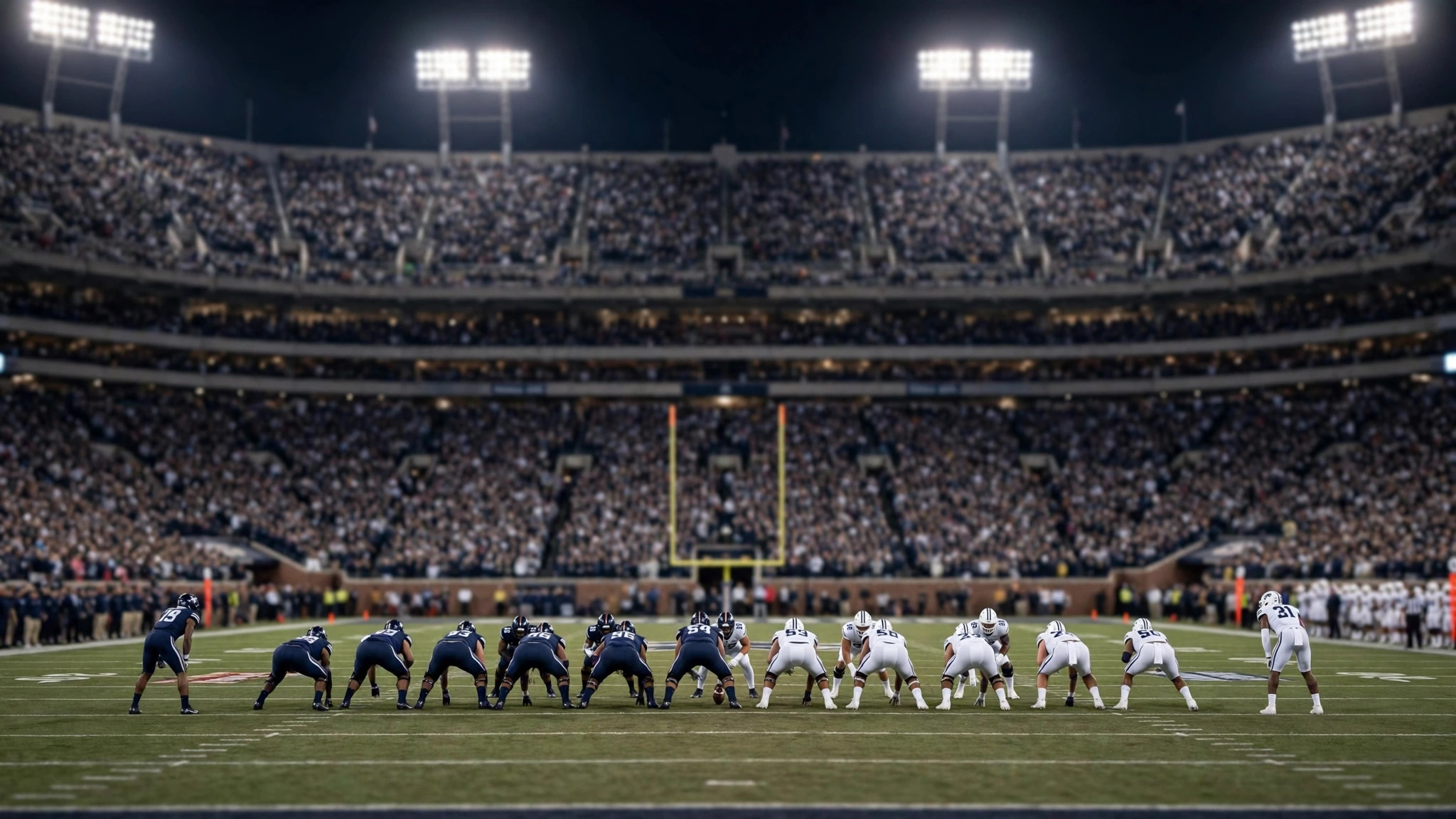
Some matchups feel brand new every season, and some carry more than a century of history into the stadium with them. The rutgers football vs penn state series belongs firmly in the second group. These two programs first met in 1918, long before television, conference title games, or the College Football Playoff existed, and they now share a home in the Big Ten Conference.
That mix of old history and modern conference stakes is what makes this game worth understanding properly. It is not the loudest rivalry in the Big Ten, and it rarely gets the national spotlight given to the league’s biggest brands. But for fans in New Jersey and Pennsylvania, it is a genuine neighborhood argument, played out once a season with bragging rights that last all year.
This guide walks through the full story: where the series started, why it disappeared for decades, how it returned when Rutgers joined the Big Ten in 2014, what game day looks like at both stadiums, and how to follow the matchup like a fan who knows the background.
Rutgers Football vs Penn State: Where the Series Began
The first meeting came on November 9, 1918, in State College, Pennsylvania. Rutgers won that day, 26-3, in an era when the sport looked nothing like the modern game. There was no forward-pass-heavy offense, no playoff, and no giant stadium on the site. College football itself was still young, and both schools were regional programs building their identities.
Remarkably, after that first game, the two teams did not meet again for 32 years. They finally played again in 1950, when Penn State earned an 18-14 win at home. A young assistant coach named Joe Paterno had just joined the Penn State staff that season, a small detail that shows how deeply this series is woven into the history of both programs.
From the 1950s onward, the meetings came in clusters. The teams played regularly through parts of the 1970s, 1980s, and early 1990s, often at neutral or shared venues in the New York and New Jersey area, including Giants Stadium. Then the series went quiet again after 1995, and for nearly two decades it looked like a finished chapter of Eastern football history.
Why the Matchup Disappeared — and Why It Came Back
College football series usually fade for practical reasons, not dramatic ones. Conference membership changed, schedules filled up with league games, and both programs went in different directions. Penn State joined the Big Ten in the early 1990s, while Rutgers spent years in the Big East and then a short stay in the American Athletic Conference.
Everything changed when Rutgers accepted an invitation to join the Big Ten, beginning play in the conference in 2014. Suddenly the old matchup had a new purpose. The Scarlet Knights’ very first Big Ten conference game was against Penn State, in Piscataway, in prime time — a fitting way to restart a series that had been dormant since 1995.
That 2014 meeting also explains the modern shape of the rivalry. This is no longer an occasional non-conference novelty. It is a scheduled conference game, with standings, bowl positioning, and recruiting battles attached to it. When two schools recruit many of the same players in the same region, every meeting carries a little extra edge.
If you enjoy the roots of the sport itself, our guide to who invented American football explains how the college game grew from those early Eastern campuses into the national spectacle it is today.
The Balance of the Series So Far
Honesty matters in a fan guide, so here it is: Penn State has dominated this series historically. Rutgers won the first meeting in 1918 and pulled off a famous upset win in 1988, a 21-16 victory remembered fondly by older Scarlet Knights fans. Outside of those moments, the Nittany Lions have won the overwhelming majority of the meetings, including every game since the series resumed in 2014 up through the most recent completed seasons covered by the record books.
That imbalance shapes how each fan base sees the game. For Penn State supporters, it is a game they expect to win, and anything close feels like a warning sign. For Rutgers supporters, it is a measuring-stick game — the kind of opponent that shows exactly how far the program has climbed in a given season.
There is a useful lesson in that for neutral fans. A lopsided series record does not make a game meaningless. It makes the underdog’s good performances memorable, and it turns every competitive fourth quarter into an event. Rutgers fans still talk about the tight 2014 game, decided late, because pushing a traditional power to the edge felt like a statement about the program’s direction.
Before kickoff, it helps to understand the rhythm of a college game. Our explainer on how many quarters are in football covers the structure, the halftime break, and how overtime works when a close game like this one refuses to be settled in regulation.
Two Stadiums, Two Very Different Game Days
Few pairings in the Big Ten offer a bigger contrast in venues. Penn State plays at Beaver Stadium in University Park, one of the largest stadiums in the world, famous for its White Out games, where more than one hundred thousand fans dress in white and create one of the loudest environments in American sports.
Rutgers plays at SHI Stadium in Piscataway, New Jersey, a far more intimate setting that sits close to the birthplace of college football — Rutgers hosted Princeton in the first intercollegiate game back in 1869. The game-day experience there leans on that history, with the program proudly calling itself the Birthplace of College Football.
Here is a quick comparison for fans planning a trip:
- Beaver Stadium (Penn State): Massive capacity, White Out tradition, tailgating fields that stretch for acres, and a small-college-town setting built entirely around game day.
- SHI Stadium (Rutgers): Easier to reach from the New York metro area, a more compact bowl, shorter lines, and a pregame atmosphere shaped by the Scarlet Walk team arrival.
- Travel note: The two campuses are roughly a three-hour drive apart, which makes this one of the easier road trips in the Big Ten for visiting fans.
- Ticket note: Demand rises sharply when either team is ranked, so buying early through official school channels is the safest habit.
Whichever stadium you choose, arrive early. The tailgating culture around both programs is half the experience, and the lots fill up long before kickoff on a conference Saturday.
What to Watch When These Teams Play
Because this is a conference game, the stakes go beyond pride. A win can shape bowl eligibility, conference standings, and the recruiting conversations that run all winter in New Jersey and Pennsylvania high schools. Coaches know that losing to a regional rival follows them into living rooms on the recruiting trail.
On the field, the matchup usually tests a few familiar themes:
- Line play: Big Ten games are often decided at the line of scrimmage, and Rutgers has built its identity around physical, disciplined football.
- Turnovers: The underdog’s clearest path in this series has always been winning the turnover battle and shortening the game.
- Special teams: In a loud road environment, one blocked kick or long return can swing momentum completely.
- Quarter depth: Conference games between physical defenses often come down to which offense sustains drives late. If you are new to game flow, our guide to how long a football game lasts explains why college games routinely run past three hours.
For official background on the series and the programs, Penn State’s athletics site has covered this matchup for decades — see Penn State’s official history of the renewed Big Ten series for details on how the 2014 return was arranged.
How to Follow the Game Each Season
Following this matchup is simple once you know where to look. The Big Ten’s television partners carry most conference games, and kickoff times are often announced one to two weeks in advance as networks make their selections. Checking both schools’ official athletics sites during game week is the most reliable routine.
A sensible game-week checklist looks like this:
- Confirm the kickoff time and TV channel on the home team’s official schedule page.
- Check the injury and depth-chart news from both beat writers and team releases.
- Look at the weather forecast — late-season games in both New Jersey and central Pennsylvania can turn cold and windy fast.
- If you are attending, review the stadium’s bag policy and parking maps before you travel.
After the game, box scores and recaps appear on the official school sites and the Big Ten’s own platforms, which is also where you will find updated conference standings.
A Rivalry Still Writing Its Next Chapter
Every season gives this series a fresh storyline. One year it is a ranked Penn State team protecting a playoff path. Another year it is a Rutgers team chasing bowl eligibility in front of its home crowd. The names on the rosters change quickly in the modern transfer era, but the geography never changes, and neither does the feeling in the stands when the visiting band starts playing.
That continuity is worth appreciating. In a sport reshaped by realignment, television money, and an expanded playoff, a game rooted in 1918 still shows up on the schedule and still matters to the people closest to it.
Frequently Asked Questions
When did Rutgers and Penn State first play?
The series began on November 9, 1918, with Rutgers winning 26-3 in State College. The teams did not meet again until 1950.
Are Rutgers and Penn State in the same conference?
Yes. Both are members of the Big Ten Conference. Penn State joined in the early 1990s, and Rutgers followed in 2014, which restarted the series as an annual-style conference matchup.
Who leads the series?
Penn State leads by a wide margin. Rutgers’ wins came in 1918 and in a memorable 1988 upset, while Penn State has won the large majority of meetings, including the modern Big Ten era games.
Where is the game played?
The site alternates between Beaver Stadium in University Park, Pennsylvania, and SHI Stadium in Piscataway, New Jersey, following the Big Ten’s scheduling rotation.
Why is Rutgers called the Birthplace of College Football?
Rutgers hosted the first intercollegiate football game in 1869, against Princeton. That game, played under soccer-like rules, is widely treated as the starting point of the American college game.
The Bottom Line
The rutgers football vs penn state matchup will probably never top the Big Ten’s marquee rivalry lists, and that is fine. Its charm is different: a series older than the forward pass era’s maturity, a long silence, and a second life as a conference game between two proud Eastern programs.
For Penn State, it is a game that protects tradition and regional dominance. For Rutgers, it is the measuring stick that never goes away. And for the rest of us, it is a reminder that college football’s history is not only written by its giants — sometimes it is written by neighbors who have been arguing, on and off, since 1918.
