

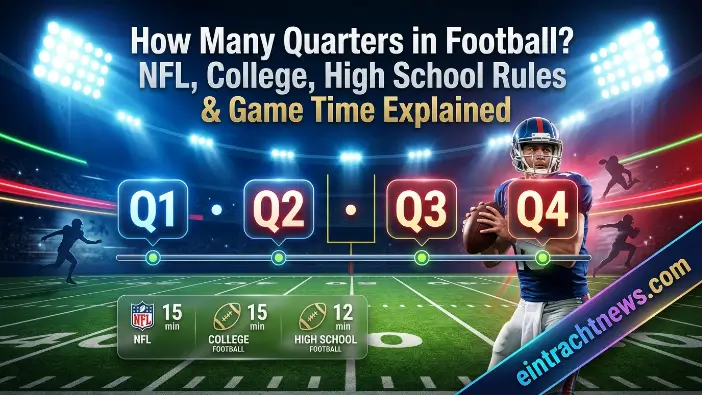
Welcome to Eintracht News! If you’re new to American football, you may wonder, how many quarters are in a football game? Understanding the game’s structure helps you follow the action, learn team strategies, and enjoy every play from kickoff to the final whistle. Whether you’re watching an NFL, college football, or high school game, the basic format is generally the same.
In this guide, we’ll explain how many quarters a football game has, how long each quarter lasts at different levels, and why a game with just 60 minutes of playing time can take more than three hours to finish. We’ll also cover overtime rules, compare American football with soccer, and answer common questions about football quarters, game duration, and timing.
Quick Answer: How Many Quarters Are in Football?
The short answer is that American football games have four quarters. This format is used in the NFL, college football, high school competitions, and many youth leagues. Each quarter makes up one part of the game’s regulation time, allowing teams to adjust their tactics, manage player energy, and prepare for the next stage of play.
A regulation football game follows this sequence:
- First Quarter
- Second Quarter
- Halftime
- Third Quarter
- Fourth Quarter
Although the structure remains the same, the length of each quarter varies based on the level of football being played.
| Level | Number of Quarters | Quarter Length | Total Regulation Time |
| NFL | 4 | 15 minutes | 60 minutes |
| College Football | 4 | 15 minutes | 60 minutes |
| High School Football | 4 | 12 minutes | 48 minutes |
| Youth Football | 4 | Usually 8–12 minutes | 32–48 minutes |
For instance, NFL and NCAA college football games feature four 15-minute quarters, while high school games typically have 12-minute quarters. Youth football leagues may use quarters lasting 8–12 minutes, depending on their rules. Although professional and college games have 60 minutes of regulation playing time and most high school games have 48 minutes, the actual event often lasts three hours or longer because of timeouts, penalties, clock stoppages, halftime, and replay reviews.
Key Takeaways
- American football is played in four quarters across most organized levels of competition.
- NFL and college football feature 15-minute quarters, adding up to 60 minutes of regulation time.
- High school games usually have 12-minute quarters, while youth leagues often use 8–12-minute quarters.
- The four-quarter structure gives teams opportunities to adjust strategies and manage player fatigue throughout the game.
- Actual game time is usually much longer than regulation time due to timeouts, clock stoppages, halftime, penalties, commercial breaks, and replay reviews.
Read Also: Where to watch florida gators football vs georgia bulldogs football
How Long Is Each Quarter in Football?
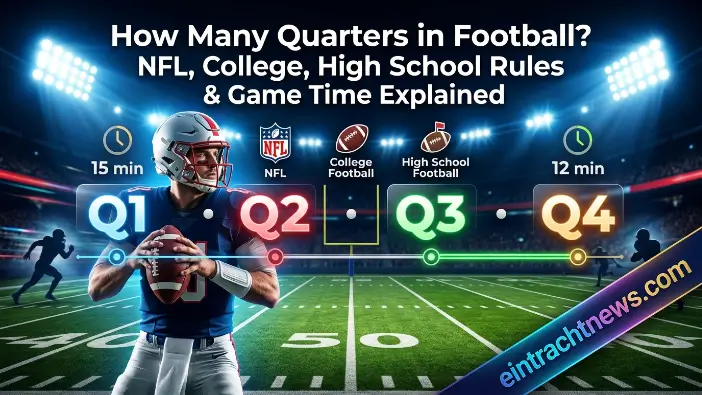
Although every American football game is divided into four quarters, the length of each quarter depends on the level of competition. Whether you’re watching the NFL, college football, high school football, or a youth league, the four-quarter format remains the same. However, the amount of time played in each quarter is adjusted to suit the players’ age, skill level, and physical demands. Understanding these differences can help new fans follow the game more easily and explain why some football games finish sooner than others. While professional games are longer and include more stoppages, youth and high school games are designed to be shorter to improve player safety and reduce fatigue.
H3: NFL Quarter Length
In the National Football League (NFL), a game consists of four 15-minute quarters, totaling 60 minutes of regulation playing time. The action starts with the first quarter, moves into the second quarter, pauses for halftime, and resumes with the third and fourth quarters.
Despite having only 60 minutes on the game clock, an NFL matchup typically lasts three hours or longer. The extra time comes from incomplete passes, players running out of bounds, penalties, injuries, timeouts, scoring plays, commercial breaks, and replay reviews. These interruptions give coaches opportunities to adjust their strategies and allow officials to review key plays and enforce the rules fairly.
H3: College Football Quarter Length
College football also features four 15-minute quarters, providing 60 minutes of regulation playing time. Its basic structure is similar to the NFL, so fans can expect many familiar rules and gameplay elements.
However, NCAA games can take longer to complete because of clock stoppages, replay reviews, halftime performances, and television breaks. As a result, many college football games last around three to three-and-a-half hours, particularly during nationally televised matchups and major rivalry games.
H3: High School Football Quarter Length
High school football games are usually shorter than NFL and college matchups. Most play with 12-minute quarters, totaling 48 minutes of regulation time.
Shorter quarters help manage player fatigue and make games more suitable for younger athletes. However, penalties, injuries, timeouts, and halftime can extend the overall duration. As a result, most high school football games last around two to two-and-a-half hours.
H3: Youth Football Quarter Length
Youth football is adapted to suit the age and skill level of younger players. Most leagues follow the four-quarter format, with each quarter typically lasting 8 to 12 minutes, depending on the age group and league rules.
Shorter quarters help reduce fatigue and give coaches more opportunities to teach basic football skills. With fewer clock stoppages and shorter halftime breaks, youth football games generally last one to two hours, making them convenient for players, coaches, and families.
Quarter Length Comparison Table
| Competition Level | Quarter Length | Total Regulation Time | Typical Game Duration |
| NFL | 15 minutes | 60 minutes | Around 3 hours |
| College Football | 15 minutes | 60 minutes | 3–3.5 hours |
| High School Football | 12 minutes | 48 minutes | 2–2.5 hours |
| Youth Football | 8–12 minutes | 32–48 minutes | 1–2 hours |
The comparison above shows that although every level of American football uses four quarters, the length of each quarter and the overall game duration vary depending on the competition.
Why Does a 60-Minute Football Game Last More Than 3 Hours?
Although NFL and college football games have 60 minutes of regulation playing time, they typically last three to three-and-a-half hours. The extra time comes from incomplete passes, players going out of bounds, penalties, timeouts, halftime, replay reviews, and television commercial breaks. These interruptions are a normal part of American football, giving coaches time to adjust their strategies and officials opportunities to review important plays.
Clock Stoppages
The biggest reason football games lOne major reason football games last longer than expected is that the game clock stops frequently. While individual stoppages may be brief, they add considerable time to the overall game.
The clock stops for several reasons, including:
- Incomplete passes: The clock stops when a pass falls incomplete.
- Players going out of bounds: The clock may stop when a ball carrier steps outside the field.
- Scoring plays: Touchdowns, field goals, and extra points pause the action before the next kickoff or play.
- First downs: Officials may briefly stop the clock to reset the chains, depending on the league and game situation.
- Penalties: Play pauses while officials assess and enforce penalties.
- Player injuries: Officials stop play when necessary to provide medical attention.
These interruptions happen repeatedly throughout a game, extending its total duration well beyond the 60 minutes of regulation playing time.
Timeouts
Each team receives a limited number of timeouts durinEach team receives a limited number of timeouts during a game. Coaches use them to stop the clock, adjust their strategy, and make important decisions.
Timeouts serve several purposes:
- Discuss strategy: Coaches communicate the next offensive or defensive play.
- Avoid penalties: Teams may call a timeout to prevent a delay-of-game penalty.
- Manage the clock: Late in close games, timeouts help teams save valuable seconds.
- Rest players: A timeout gives players a brief opportunity to recover before the next play.
In close football games, effective timeout management can play a crucial role in determining the final result.
Commercial Breaks
Television broadcasts also add to the total game length. Commercial breaks are scheduled throughout the game to pTelevision broadcasts also contribute to the length of a football game by including commercial breaks. These interruptions provide advertising time for broadcasters and often occur at key moments during the game.
Commercial breaks commonly happen:
- After scoring plays: Touchdowns and field goals often lead to brief television breaks.
- During changes of possession: Broadcasters may show advertisements when teams switch between offense and defense.
- At the end of each quarter: Quarter breaks provide natural opportunities for commercials.
- During official TV timeouts: Some stoppages are scheduled specifically for television coverage.
- Around halftime: Longer breaks include advertisements, expert analysis, and game highlights.
Although these pauses may feel brief in the stadium, they add to the total viewing time for television audiences.
Halftime
Halftime takes place after the second quarter, giving players and coaches time to prepare for the second half of the game.
During halftime:
- Coaches review performance: They analyze the first half and adjust their strategies.
- Players rest and recover: Teams take a break before returning to the field.
- Medical staff assess injuries: Healthcare professionals treat injured players and check their condition.
- Broadcasters provide analysis: Commentators review key plays, discuss team performance, and preview the second half.
The length of halftime varies by league and event, with major games sometimes featuring extended breaks for special entertainment.
| Level | Typical Halftime Length |
| NFL | About 12–13 minutes |
| College Football | Around 20 minutes |
| High School | Approximately 15–20 minutes |
| Youth Football | Usually 10–15 minutes |
Major college games and championship events may have longer halftime shows, which can extend the overall game time even further.
Replay Reviews
Modern football uses instant replay to help officialReplay reviews help officials make accurate decisions during crucial moments of a football game. They use video footage to review certain plays and confirm whether the original ruling was correct.
Replay reviews may be used to check:
- Completed catches: Officials determine whether a receiver caught and maintained control of the ball.
- Goal-line plays: They check whether the ball crossed the goal line for a touchdown.
- Fumbles and possession: Video helps establish which team recovered a loose ball.
- Boundary rulings: Officials review whether a player remained in bounds during a play.
- Other reviewable plays: Additional situations may be reviewed according to league rules.
Although replay reviews can extend game time, they help improve officiating accuracy and ensure that important decisions are based on the available evidence.
What Happens Between Football Quarters?
Breaks between football quarters serve several important purposes. They allow players to recover, coaches to adjust their strategies, and officials to prepare for the next period of play. While the breaks between the first and second quarters and the third and fourth quarters are usually brief, they help keep the game organized.
The longest break occurs at halftime, when players return to the locker room to rest and prepare for the second half.These breaks can influence the game’s outcome, as effective coaching adjustments and refreshed players may give a team an advantage when play resumes.
End of First Quarter
When the first quarter ends, the game pauses briefly before the second quarter begins. Unlike halftime, this break usually lasts only a short time. During the pause, teams switch ends of the field to ensure fair playing conditions.
Coaches may also use this opportunity to make quick tactical adjustments, remind players of their responsibilities, and address mistakes from the opening quarter. Even though the break is brief, it helps teams regroup and prepare for the next stage of the game.
Halftime Break
Halftime takes place after the secondDuring halftime, both teams use the break to rest, review their performance, and prepare for the second half.
- Players rest and recover: They regain energy before returning to the field.
- Coaches review performance: They identify strengths, weaknesses, and areas for improvement.
- Teams adjust strategies: Coaches modify their game plans based on the opponent’s performance.
- Medical staff treat injuries: They assess injured players and help determine whether they can continue.
- Officials prepare for the second half: They get ready for the remaining quarters and address relevant game situations.
Halftime also adds to the fan experience. Television broadcasts feature expert analysis, highlights, and interviews, while college and high school games may include marching band performances or other entertainment.
Third Quarter
The third quarter begins the second half of the game and can be a turning point for either team. The team that did not receive the opening kickoff typically receives the kickoff to start the second half, following the rules of the game.
This quarter is when teams put their halftime adjustments into action. Coaches may change tactics to exploit weaknesses in the opposing team, strengthen their defense, or improve offensive performance. For a team that struggled in the first half, the third quarter offers an important opportunity to regain momentum and take control of the game.
Fourth Quarter
The fourth quarter is widely considered the most important and exciting part of a football game because it determines the fin The fourth quarter often determines the final outcome of a football game. As time runs out, every possession becomes more important, and teams adjust their strategies based on the score.
During the fourth quarter:
- Offenses become more aggressive: Teams that are behind may take greater risks to score quickly.
- Defenses protect the lead: Teams ahead focus on stopping the opponent and forcing turnovers.
- Clock management becomes critical: Every second matters, especially in close games.
- Coaches manage timeouts carefully: They use their remaining timeouts to stop the clock, plan important plays, or protect a lead.
The fourth quarter often produces some of football’s most memorable moments, including game-winning touchdowns, last-second field goals, dramatic comebacks, and crucial defensive stops.
What Happens After the Fourth Quarter?
When the fourth quarter ends, regulation play is complete. If one team has more points, it wins the game. However, if the score is tied, the game may proceed to overtime, depending on the rules of the league or competition.Overtime provides a way to determine the winner when teams finish regulation with equal scores.
NFL Overtime Rules
In regular-season NFL games, overtime is played under modified sudden-death rules. A coin toss determines which team receives the ball fiNFL overtime rules aim to provide both teams with a fair opportunity to win, although the outcome of the opening possession can still play a major role.
Key features include:
- Coin toss: The winning team chooses whether to receive the kickoff or defer its choice.
- Opening-possession touchdown: Under current NFL rules, a touchdown on the opening drive does not automatically end overtime. The opposing team gets an opportunity to possess the ball.
- Opening-possession field goal: If the first team scores a field goal, the opposing team can match it to extend the game or score a touchdown to take the lead.
- Sudden death: After both teams have had an opportunity to possess the ball, the next score can decide the game.
- Regular-season ties: If the score remains tied when the 10-minute overtime period expires, the game ends in a tie.
These rules help balance competitive fairness with player safety by limiting the length of regular-season overtime.
College Football Overtime Rules
College football follows a different overtime system that guarantees both teams an offensive possession, making it different fromCollege football overtime follows a different format from the NFL. Instead of starting with a traditional kickoff, teams take turns running offensive possessions from a designated spot on the field. Each team has an opportunity to score, and the outcome determines whether the game continues.
The procedure works as follows:
- First possession: One team begins its offensive series from the opponent’s 25-yard line.
- Equal opportunity: The opposing team then gets a chance to respond with its own possession.
- Additional overtime periods: If the score remains tied, further overtime periods continue until a winner is determined.
- Later overtime rules: Starting in the second overtime, teams must attempt a two-point conversion after scoring a touchdown. From the third overtime onward, teams alternate two-point conversion attempts rather than running full offensive possessions.
This format often produces exciting, high-scoring finishes because both teams have opportunities to respond directly to each other’s performance.
Regular Season vs Playoffs
Overtime rules can also change depending on whether the game is partOvertime rules can vary depending on whether a game is part of the regular season or the playoffs.
For example:
- NFL playoffs: Games continue through additional overtime periods until a winner is determined.
- College football playoffs: Teams play additional overtime periods until one team wins.
- High school football: Rules vary by state, but games generally continue with additional overtime periods until a winner is decided.
These differences explain why some football games end shortly after regulation, while others require several overtime periods to determine the winner.
Football Quarters vs Soccer Halves
One of the most common sources of confusion for sports fans is the difference between American football and association football (soccer). Although both sports are called “football” in many parts of the world, they follow different rules and timing systems. American football is divided into four quarters, giving teams regular breaks to adjust their strategies, while soccer is played in two 45-minute halves with a mostly continuous clock. These differences create a unique pace and flow for each sport.
Comparison Table
| American Football | Soccer |
| 4 quarters | 2 halves |
| 60 minutes of regulation (NFL & College) | 90 minutes of regulation |
| Clock stops frequently | Clock runs continuously |
| Halftime after the second quarter | Halftime after the first half |
| Overtime rules vary by league | Extra time and penalty shootouts depend on the competition |
If you’re searching “how many quarters in football,” the answer depends on which type of football you mean. American football always uses four quarters, while soccer does not use quarters at all. Instead, it follows a two-half format, making it one of the biggest structural differences between the two sports.
Football Quarter Length Comparison Table
The table below compares quarter length, total regulation playing time, and average game duration across different levels of American football. Although most levels follow the same four-quarter format, quarter lengths vary depending on the age group and level of competition.
| Competition Level | Number of Quarters | Quarter Length | Total Regulation Time | Typical Game Duration |
| NFL | 4 | 15 minutes | 60 minutes | Around 3 hours |
| College Football | 4 | 15 minutes | 60 minutes | 3–3.5 hours |
| High School Football | 4 | 12 minutes | 48 minutes | 2–2.5 hours |
| Youth Football | 4 | 8–12 minutes | 32–48 minutes | 1–2 hours |
As the table shows, the number of quarters remains the same across all levels of American football, but the length of each quarter and the overall game duration vary depending on the competition. Professional and college football feature longer quarters and more clock stoppages, while high school and youth leagues use shorter quarters to better suit younger athletes and improve player safety.
Common Mistakes About Football Quarters
Even experienced sports fans can misunderstand how American football games work. These misconceptions often arise from confusing American football with soccer or assuming that all leagues follow identical rules. Although the game follows a simple four-quarter structure, quarter lengths, total game duration, and overtime rules vary by competition level. Understanding these differences makes it easier to follow the action, recognize key strategies, and enjoy all four quarters of the game.
Mistake 1: Thinking Football Has Two Halves Everywhere
One common misconception is that all types of football are played in two halves. This confusion often comes from soccer, which has two 45-minute halves. In contrast, American football is divided into four quarters, each representing one-fourth of regulation playing time.
Although there is a halftime break after the second quarter, the game still consists of four separate periods. Understanding this distinction makes it easier to follow American football and recognize how the game is structured.
Mistake 2: Believing Every Football Game Lasts Exactly 60 Minutes
Another common misconception is that NFL and college football games end after exactly 60 minutes. Although regulation playing time is 60 minutes, the actual game takes considerably longer.
The game clock stops for incomplete passes, players going out of bounds, penalties, injuries, timeouts, scoring plays, and replay reviews. Television broadcasts also include commercial breaks, adding to the total duration. As a result, most NFL and college football games last around three to three-and-a-half hours, making the overall viewing experience much longer than the official playing time.
Mistake 3: Assuming Quarter Length Is the Same at Every Level
Another common misconception is that all football games have the same quarter length. While the four-quarter format remains consistent, the length of each quarter varies by competition level.
The NFL and college football use 15-minute quarters, high school football typically uses 12-minute quarters, and youth leagues often use quarters lasting 8 to 12 minutes. These differences help accommodate players’ ages and development while preserving the basic structure of the game.
Mistake 4: Confusing Overtime Rules
Overtime rules are another common source of confusion for football fans. The NFL, college football, high school football, and youth leagues each follow different procedures for deciding tied games. For example, college football uses a possession-based format, while the NFL has its own overtime rules. Understanding these differences helps explain what happens when a game extends beyond regulation time.
By clearing up these misconceptions, you’ll better understand football quarters, game duration, and overtime rules. Whether you’re watching an NFL, college, or high school game, knowing the basics makes it easier to follow the action and enjoy every moment.
Tips for New Football Fans
If you’re new to American football, undUnderstanding how American football is structured makes it easier to follow and enjoy the game. Learning about quarters, the game clock, and time management also helps explain why teams make different decisions throughout a match.
Here are some helpful tips for new fans:
- Watch the game clock: Track the time remaining in each quarter to understand how it influences team strategy.
- Learn when the clock stops: Familiarize yourself with stoppages caused by incomplete passes, penalties, and players going out of bounds.
- Notice halftime adjustments: Coaches often change their strategies during halftime, potentially shifting the game’s momentum.
- Pay attention to timeouts: Timeout management becomes especially important in the fourth quarter, when every second counts.
- Distinguish playing time from total duration: Regulation lasts 60 minutes in the NFL and college football, but stoppages, halftime, and commercial breaks make games much longer.
- Don’t confuse American football with soccer: American football has four quarters, while soccer is played in two halves, with different timing rules.
The more games you watch, the easier it becomes to understand football quarters, game timing, and clock management. With practice, you’ll recognize key strategies, follow the action more confidently, and enjoy every stage of the game.
Frequently Asked Questions
Can a football game end before all four quarters are completed?
No. Under normal circumstances, every regulation game is played through all four quarters unless it is officially suspended or canceled because of severe weather or other exceptional situations.
Why do teams switch ends of the field after each quarter?
Teams switch ends to ensure both sides play under the same field and weather conditions, helping keep the game as fair as possible.
Do all youth football leagues use the same quarter length?
No. Quarter length varies by league, age group, and local rules, so younger players often have shorter quarters than older youth divisions.
Can a team win without scoring in every quarter?
Yes. A team can score all of its points in one or two quarters and still win if the opponent finishes with fewer total points.
Why is understanding football quarters important for new fans?
Knowing how quarters work helps you follow the game’s pace, understand coaching decisions, and enjoy the strategies that unfold from kickoff to the final whistle.
Conclusion
Understanding how many quarters are in football is a key step toward enjoying American football. Every game has four quarters, but their length varies by competition level. NFL and college football use 15-minute quarters, while high school and youth leagues often have shorter periods. Understanding this structure helps fans follow the action and see how each quarter can influence the final result.
A football game also takes longer than its official playing time because of clock stoppages, timeouts, halftime, replay reviews, and other breaks. Learning how quarters, game timing, and overtime work makes it easier to understand team strategies and enjoy watching the NFL, college football, or local games with confidence.
