

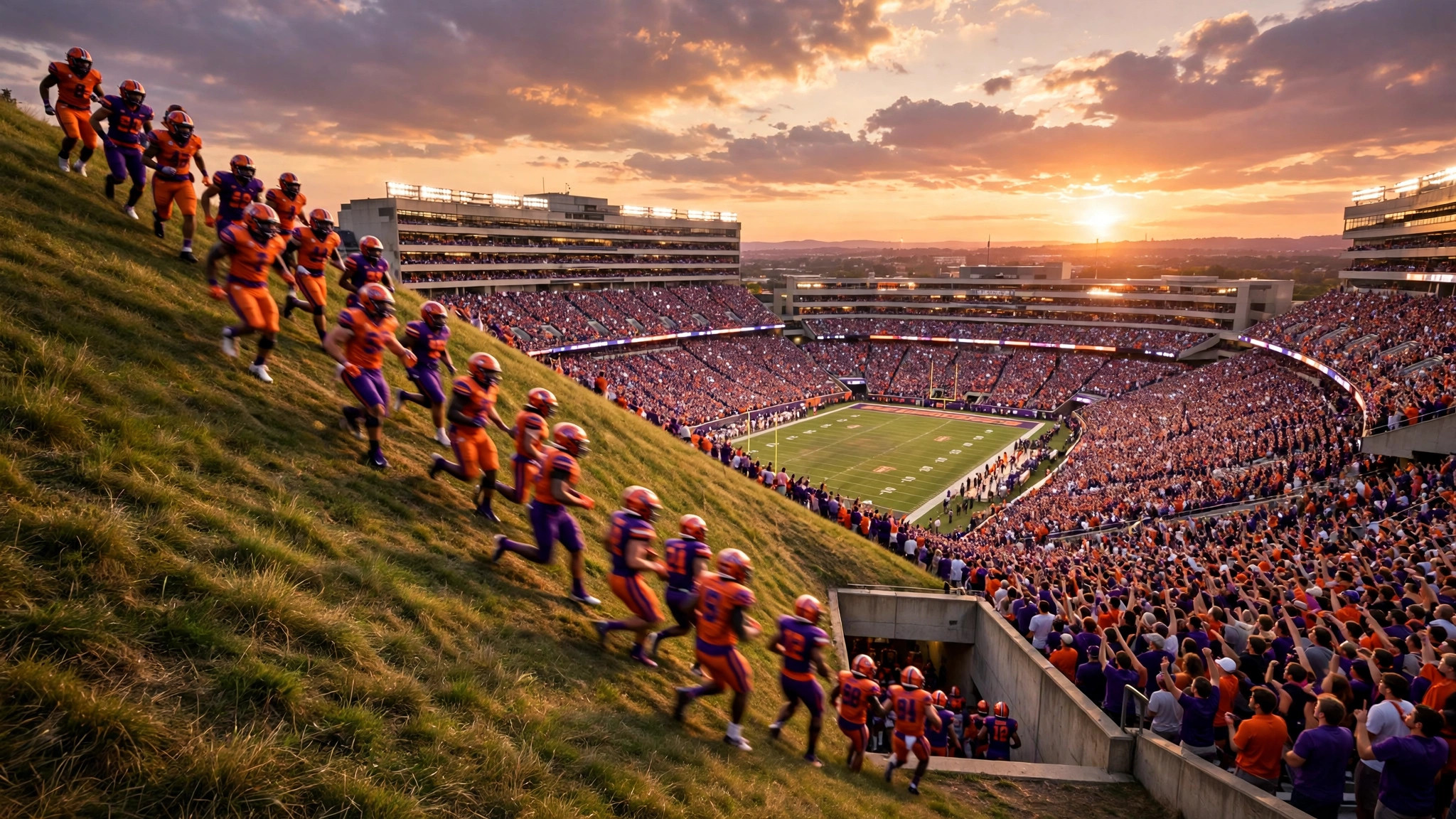
There are louder stadiums, and there are bigger ones, but there may not be a more theatrical entrance in sports than the one at Clemson. A bus ride around the stadium, a hand on a rock, a sprint down a steep grass hill — and suddenly clemson football makes complete sense. This is a program built on tradition, confidence, and a small South Carolina town that revolves entirely around its Tigers.
This guide walks through the whole world of the program: the championships, Death Valley, Howard’s Rock, the Dabo Swinney era, and the practical basics of attending a game or following from home. Whether you are a new fan, a curious neutral, or an opponent doing homework, here is clemson football explained properly.
Clemson Football at a Glance
Clemson University sits in the foothills of the Blue Ridge Mountains in upstate South Carolina, and its football team is the region’s beating heart. The Tigers play in the Atlantic Coast Conference, wear orange and purple — officially orange and regalia — and answer to one of the most loyal fan bases in America.
The program’s modern identity was forged under head coach Dabo Swinney, whose tenure turned a good program into a national power. But Clemson’s story stretches far beyond one era, and the locals will happily tell you all of it if you give them a tailgate and ten minutes.
The essentials for any new fan:
- Home: Memorial Stadium, nicknamed Death Valley, holding about 81,500 fans
- Conference: ACC
- Colors: Clemson orange and regalia purple
- National championships: 1981, 2016, and 2018
- Signature tradition: rubbing Howard’s Rock and running down the hill
Three National Championships, Three Different Eras
Clemson’s first national title arrived in 1981, a perfect season that announced the Tigers as a genuine national force and remains a sacred memory for older fans. For decades afterward, that championship stood alone — proof of what the program could be, and a standing question about whether it would ever happen again.
The answer came in the College Football Playoff era. Clemson won the national championship for the 2016 season in a classic final, then did it again for 2018, completing an undefeated season that cemented the Tigers as one of the defining programs of the playoff age. Two titles in three years turned clemson football from a regional power with potential into a program every recruit in America had to consider.
What unites all three titles is the setting. Clemson is not a big-city program with endless natural advantages. Each championship was built in a small town, by rosters developed patiently, in a stadium that squeezes every decibel out of its people. That is the charm of the place, and it is why the titles mean so much here.
Death Valley: The Stadium That Roars
Memorial Stadium earned its Death Valley nickname long ago, and about 81,500 fans do their best to honor it every Saturday. Built into a natural valley, the stadium traps sound beautifully, and when the Tigers are rolling, the noise rolls down the hillside and sits on top of visiting offenses like weather.
The east end zone is where the magic lives. That is where the hill is — the steep grass bank the team charges down — and where students pack in to create the stadium’s signature visual: a wall of orange shaking as the cannon fires and the band strikes up.
If you visit, give yourself time to simply take the place in. Walk the tailgate fields that stretch in every direction, because Clemson on a game day is essentially the entire town turned into one festival. Our Clemson football schedule guide helps you pick the right Saturday, from early-season warm-ups to the ACC games that shake the valley.
Howard’s Rock and the Most Exciting 25 Seconds
Now for the tradition that defines clemson football. Before home games, the team buses around the stadium, gathers at the top of the hill, and touches Howard’s Rock — a stone from the real Death Valley in California, mounted on a pedestal above the field since the late 1960s. Then, to a cannon blast and a roar, the Tigers run down the hill into the stadium.
The entrance has famously been called “the most exciting 25 seconds in college football,” and the remarkable thing is that the description undersells it in person. The hill is genuinely steep, the players genuinely sprint, and the sound genuinely feels physical. It is part pep rally, part dare, and completely Clemson.
The rock itself is treated with near-sacred respect. It is not a prop; it is a promise — generations of players have touched it as a reminder of the standard they are about to represent. Visitors who understand that tend to leave with a little more respect for the whole operation, even the ones wearing the wrong colors.
The Dabo Swinney Era
No modern guide to clemson football can skip the head coach. Dabo Swinney took over the program and built it the slow way: recruiting relentlessly, developing players over years, and selling a culture summed up in phrases the whole sport can now recite. The results — two national championships and a long run of ACC dominance — speak plainly enough.
Swinney’s Clemson became known for a few repeatable strengths. Elite defensive lines that wrecked game plans. Quarterback play at the highest level when it mattered most. And a knack for peaking in the biggest games, when the lights were brightest and the opponent was supposedly more talented.
Just as notable is what the era did to the town. Recruiting visits became events, facilities became showcases, and little Clemson became a mandatory stop on the national football calendar. Whatever comes next for the program, the Swinney years reset the ceiling permanently — fans here now measure seasons by playoff standards, and the program embraces that pressure rather than hiding from it.
Life in the ACC
Clemson’s conference home is the ACC, which means annual battles with familiar faces and a schedule that mixes old rivalries with tricky road trips. The Tigers’ league slate has long included programs like Duke football and Wake Forest, games Clemson is expected to win and can absolutely lose if it shows up flat.
That expectation is the tax of being the hunted. For years, Clemson has worn the ACC’s target, and every opponent circles the Tigers’ visit months in advance. Handling that weekly pressure — on the road, at night, in stadiums desperate for a signature win — is a skill in itself, and the great Clemson teams mastered it.
The rivalry that towers above the conference slate is the in-state war with South Carolina, a game that divides households across the state and needs no championship stakes to feel enormous. Add traditional matchups with Florida State and Georgia Tech, and the Clemson calendar never lacks for afternoons that matter.
How the Roster Is Built
Clemson recruits nationally now, but the foundation remains development. The program’s best teams were built on players signed, redshirted, coached up, and unleashed as veterans — a pipeline that requires patience from players and trust in the staff. When it works, the Tigers roll out waves of experienced starters while younger opponents are still learning on the job.
The defensive front became the program’s calling card, producing a assembly line of disruptive linemen that NFL scouts treat as an annual appointment. Offensively, the Tigers have cycled through styles while keeping one constant: explosive plays are expected, not celebrated as surprises.
For fans, the practical advice is simple. Trust the official roster and depth chart published by the school during the season, be skeptical of summer depth-chart rumors, and remember that at Clemson, the two-deep is usually deeper than it looks. The next star is often a patient sophomore nobody outside the building has been watching.
Tickets, Tailgates, and Visiting Clemson
Attending a game in Clemson is a pilgrimage worth planning. The town is small, lodging fills quickly on football weekends, and many fans stay in nearby communities and drive in early. Tailgating is not a sideshow here — it is a full-day institution, with fields of orange tents stretching as far as you can see.
Inside the stadium, sit anywhere and you will feel the hill entrance, but first-timers often love the energy near the student sections. Dress in layers for late-season games, because those foothill evenings turn cold fast once the sun drops behind the stadium.
A few tips for your first trip:
- Book lodging as early as possible; game weekends sell out the whole region
- Arrive hours before kickoff to experience the tailgate scene properly
- Be in your seat early — you do not want to miss the run down the hill
- Build in time after the game, because postgame Clemson is a celebration of its own
How to Follow the Tigers From Anywhere
Most Clemson games land on national television through the ACC’s broadcast partners, with kickoff times set as the season unfolds. The school’s official athletics site, ClemsonTigers.com, is the reliable first stop for schedules, roster news, and ticket information, and the program’s social channels are famously active during game weeks.
If you are planning your Saturdays around kickoff, our explainer on how long a football game lasts is a handy companion for scheduling the rest of the day. And for fans who follow several ACC programs, keeping one good live-score app handy turns even a Clemson bye week into a full afternoon of scoreboard watching.
Frequently Asked Questions
Why is Clemson’s stadium called Death Valley?
Memorial Stadium’s nickname grew from its valley setting and the graveyard on the hill overlooking it, and it stuck because the place is famously miserable for visiting teams. The team even touches a rock from California’s Death Valley before running down the hill.
How many national championships has Clemson won?
Three: 1981, and the College Football Playoff titles for the 2016 and 2018 seasons.
What is Howard’s Rock?
A stone from Death Valley, California, placed at the top of the hill in the late 1960s. Players rub it for luck before charging down into the stadium — the entrance known as the most exciting 25 seconds in college football.
Who is Clemson’s head coach?
Dabo Swinney, the coach who led the Tigers to the 2016 and 2018 national championships and turned the program into a perennial playoff contender.
The Bottom Line
Clemson football is what happens when a small town, a steep hill, and a rock become the foundation of a national power. Three championships, a stadium that shakes, and an entrance the whole sport stops to watch — all of it built in a place outsiders once overlooked.
Come for the hill if you like. Everyone does. But stay for the football, because clemson football has spent a decade proving that what happens after those 25 seconds matters even more.
