

Many sports enthusiasts, students, and casual viewers often ask, how long is a football field? Although the answer may seem straightforward, several factors determine the total length, including the playing area, end zones, and overall field dimensions. Understanding these measurements makes it easier to follow the game and compare field sizes accurately.
Whether you’re watching an NFL game, attending a high school football match, or using a football field to estimate distances, knowing its exact dimensions can be helpful. In this guide, we’ll explore football field dimensions in yards, feet, and meters, compare football fields with soccer fields, and cover other important measurements you should know.
The Quick Answer: Standard Football Field Length
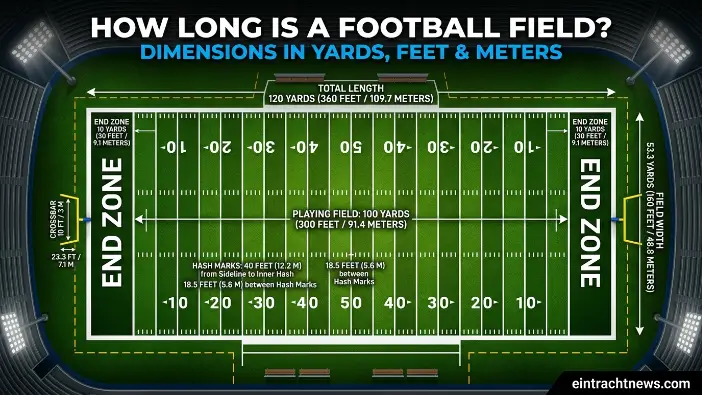
If you’re asking how long is a football field, a standard American football field measures 120 yards from end to end, including both end zones. This total length covers the entire field, from one end line to the opposite end line.
A regulation football field consists of two main sections: the playing field and the end zones. The main playing area is 100 yards long, where most of the action takes place. At each end, there’s a 10-yard end zone where teams score touchdowns. Together, these two end zones add another 20 yards, bringing the field’s total length to 120 yards.
Length Including End Zones
When measuring the complete football field from one end line to the other, the dimensions are:
| Measurement | Length |
| Yards | 120 yards |
| Feet | 360 feet |
| Meters | 109.7 meters |
ThThe total length of an American football field is calculated by adding the main playing area and the two end zones:
- 100 yards: The main playing field
- 10 yards: The first end zone
- 10 yards: The second end zone
Therefore, when broadcasters, coaches, or official rulebooks refer to the full length of a regulation football field, they generally mean the entire 120-yard field, including both end zones.
Length of the Playing Field Only
The central section of the field, where players run offensive and defensive plays, is known as the playing field.
This area stretches between the two goal lines and measures:
| Measurement | Length |
| Yards | 100 yards |
| Feet | 300 feet |
| Meters | 91.4 meters |
Understanding this distinction helps eliminate one of the most common misconceptions about football field dimensions.
Read Also: where to watch indiana hoosiers football vs oregon ducks football
Football Field Dimensions Explained
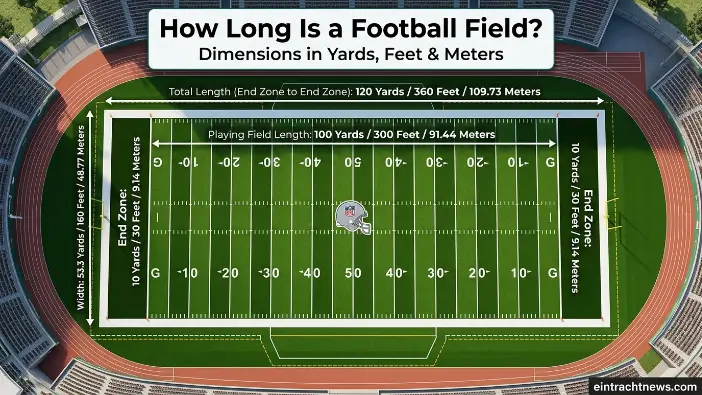
To understand how long is a football field, it’s helpful to consider all its dimensions, not just its length. A standard American football field has specific measurements to maintain consistency across different levels of the game. Its width, end zones, and yard lines all serve important purposes and help define how the game is played.
Field Width
While the length of a football field often gets the most attention, its width is just as important. A standard American football field is 53.3 yards wide, equal to 160 feet or approximately 48.8 meters. These dimensions remain consistent across professional, college, and high school football, providing a uniform playing area at different levels of the sport.
The standardized width allows teams to use their strategies and plays on different fields without adjusting to changes in size. Whether playing in an NFL stadium or at a local high school, athletes can expect the same distance between the two sidelines.
The width of a standard football field is:
- 53.3 yards
- 160 feet
- 48.8 meters
End Zones
At each end of the football field is an area known as the end zone, which is where teams score touchdowns. Each end zone extends 10 yards deep beyond the goal line, adding valuable scoring space to the field.
The dimensions of each end zone on a standard American football field are:
- 10 yards deep
- 30 feet deep
- Approximately 9.1 meters deep
Since a football field has two end zones, they add a total of 20 yards to the field’s overall length. This brings the full length of a regulation football field to 120 yards, while the main playing area measures just 100 yards.
Yard Lines and Hash Marks
A football field is marked with a series of lines that help players, coaches, officials, and fans understand field position during a game. The most noticeable markings are the yard lines, which run across the width of the field at regular intervals.The field also features yard lines, which extend across its width at regular intervals to help players and officials track the ball’s position.
Yard lines are marked every five yards, while large numbers usually appear every ten yards to show the distance from the nearest end zone. These markings help teams measure their progress toward a first down or a touchdown.
Hash mark spacing varies by level of play:
- NFL football: Hash marks are closest together.
- College football: Hash marks are farther apart.
- High school football: Hash marks are generally the widest apart.
These differences can influence ball placement on the field and affect teams’ offensive strategies.
Total Playing Area in Acres and Square Feet
A standard American football field covers a significant amount of space, including the main playing area and both end zones. Its total dimensions make it a large sports surface, designed to provide enough room for players to run, pass, defend, and score touchdowns throughout the game.
When including both end zones, the total area of a regulation football field is:
| Measurement | Size |
| Square Feet | 57,600 sq ft |
| Acres | Approximately 1.32 acres |
Because of its large and easily recognizable size, a football field is often used as a reference unit in news reports, construction projects, and weather forecasts. For example, large areas affected by storms or wildfires are frequently described in terms of “football fields” to help people visualize the scale.
How Long Is an NFL Football Field?
An NFL football field is designed according to strict standards set by the league to ensure that every game is played under consistent conditions. No matter which stadium hosts a game or where it is located, all NFL teams play on fields with the same official dimensions. These uniform measurements help create a fair playing environment, maintain consistency across the league, and protect the integrity of the game. They also ensure that players, coaches, and officials can rely on the same field layout throughout the NFL season.
NFL Field Dimensions
The National Football League (NFL) follows specific field dimensions that have remained largely consistent over the years. A standard NFL football field measures 120 yards in total length, including both end zones. However, the main playing area between the two goal lines is 100 yards long, providing space for teams to advance the ball and compete throughout the game.
The official dimensions of an NFL football field are outlined below:
| Dimension | Size |
| Length Including End Zones | 120 yards |
| Playing Area Length | 100 yards |
| Width | 53.3 yards |
| End Zone Depth | 10 yards |
Because all NFL fields share the same size, players and coaches can develop strategies without needing to adjust to different field dimensions from one stadium to another.
Why NFL Fields Use Standard Measurements
Standardized NFL field dimensions play an important role in ensuring fairness and competitive balance throughout the league. If stadiums had different field sizes, some teams might gain an unfair advantage when playing at home. By requiring every team to follow the same measurements, the NFL creates a consistent playing environment where all teams compete under equal conditions.
Uniform field dimensions are also important for maintaining accurate records and analyzing game statistics. Because every NFL field follows the same layout, player performances, team results, and historical records can be compared fairly across different stadiums and seasons.
Are College and High School Football Fields Different?
Many people believe that football fields differ greatly in size depending on the level of competition. However, college and high school football fields are generally very similar in overall dimensions to those used in the NFL. Although certain field markings, rules, and other details may vary between levels, the basic playing surface remains nearly the same across American football. This consistency makes it easier for players to adapt as they move between different levels of competition while maintaining a familiar field layout.
College Football Field Size
College football fields use the same standard dimensions as professional NFL fields. The main playing area measures 100 yards long, while the total field length, including both end zones, extends to 120 yards. The field is also 53.3 yards wide, providing players with the same amount of space found in professional games.
The standard dimensions of a college football field include the following:
- 100-yard playing field
- 120-yard total length, including both end zones
- 53.3-yard width
Although a college football field has the same overall dimensions as an NFL field, one key difference is the placement of the hash marks.
High School Football Field Size
Most high school football fields also follow the same overallA standard high school football field generally follows these dimensions:
- 100 yards of playing area
- 120 yards in total length, including both end zones
- 53.3 yards in width
High school football fields share the same basic dimensions as college and professional football fields, making it easier for players to transition between different levels of competition.
Key Differences Between Levels
While NFL, college, and high school football fields share similar overall dimensions, one key difference is the placement of the hash marks. These markings vary by level of play and affect where the ball is positioned for each down.
| Feature | NFL | College | High School |
| Field Length | 120 yards | 120 yards | 120 yards |
| Width | 53.3 yards | 53.3 yards | 53.3 yards |
| Hash Marks | Narrow | Wider | Widest |
The wider spacing of hash marks in college and high school football creates more room on one side of the field, which can affect play-calling and game strategy.
How Long Is a Soccer Field Compared to a Football Field?
Comparing football fields with other sports fields is a simple way to understand the true size of an American football field. Although American football fields follow standardized dimensions, soccer fields allow more variation in their length and width. Their measurements can differ based on the level of competition and the regulations established by the governing organization.
Soccer Field Dimensions
Unlike American football, soccer does not require every field to have identical measurements. Instead, organizations such as FIFA provFIFA regulations establish an acceptable range of dimensions for soccer fields, allowing stadiums to meet specific size requirements while accommodating different playing environments.
According to FIFA regulations, a soccer field can have the following dimensions:
- Length: 100 to 130 yards (90 to 120 meters)
- Width: 50 to 100 yards (45 to 90 meters)
This flexibility means soccer fields can vary in size from one stadium to another, unlike American football fields, which follow standardized dimensions.
Football vs Soccer Field Comparison
The table below provides a detailed comparison of the major differences between a standard American football field and a soccer field. It highlights key aspects such as field length, width, total playing area, and dimensional requirements, helping readers understand how the two sports differ in terms of field size and layout.
| Feature | Football Field | Soccer Field |
| Length | 120 yards | 100–130 yards |
| Width | 53.3 yards | 50–100 yards |
| Shape | Fixed size | Variable size |
Understanding the differences between these playing surfaces provides a useful perspective when comparing sports venues or visualizing field sizes. It’s also why terms such as football field vs soccer field and soccer field size are commonly searched by sports fans, students, and curious readers looking to better understand sports field dimensions.
Why Is a Football Field Exactly 100 Yards Long?
The dimensions of a modern American football field were not established all at once. They developed gradually as the sport evolved and rules became more organized. The decision to adopt a 100-yard playing field was shaped by the early history of football, the need to ensure fair competition, and the goal of creating a consistent playing environment. Over time, standardized measurements helped establish uniform rules, allowing teams to compete on fields of the same size regardless of the stadium or location.
Historical Background
American football developed from rugby and soccer during the late 19th century. In its early stages, the sport did not have a universal set of rules for field dimensions, so the length and width of playing fields often differed from one school or club to another. These variations sometimes created difficulties during games, as teams had to adjust to different field sizes whenever they played at a new venue.
The absence of standardized field measurements also made it challenging to maintain consistent rules, compare team performances, and organize fair competitions. As American football continued to grow in popularity at colleges and universities, officials and sports organizations recognized the importance of establishing uniform field dimensions.
Evolution of Modern Football Field Dimensions
During the early 1900s, football administrators introduced standardized field measurements that closely resemble those usedAs American football continued to develop, administrators and sports officials introduced standardized field measurements that closely resemble the dimensions used today. The main playing area was established at 100 yards long, with two 10-yard end zones added at opposite ends of the field. This layout helped create a consistent playing environment and became an important part of the sport’s modern structure.
This standardized configuration offered several key advantages:
- It provided a balanced playing area for both offensive and defensive strategies.
- It clearly defined the touchdown areas, making scoring easier to understand.
- It improved consistency in field markings, game organization, and officiating.
- It ensured that teams competed under the same field conditions, regardless of the venue.
Over time, these measurements became firmly established as the standard for professional, college, and high school American football. Today, the dimensions of a regulation football field are widely recognized and used across the sport.
Common Ways People Use Football Fields as Measurements
American football originated from rugby and soccer in the late 19th century. During the early development of the sport, there were no universally accepted rules defining the size of a football field. As a result, playing fields varied considerably in both length and width, depending on the school, college, or club hosting the game. These differences sometimes caused difficulties for teams, as players had to adjust their strategies and playing styles to accommodate different field dimensions at each venue.
Weather Reports and Natural Disasters
Meteorologists and news organizations frequently use football fields as a familiar reference point when explaining the size, width, or extent of severe weather events. Tornado damage paths, wildfire-affected regions, and flood-covered areas may be compared to football fields to help audiences visualize the scale of the destruction more easily. Rather than relying only on technical measurements, this comparison gives readers and viewers a more practical understanding of how large an affected area may be.
For example, a weather report might describe a tornado by saying:
- “The tornado carved a path nearly 15 football fields wide.”
In the same way, news coverage of a major wildfire may compare the burned area to hundreds or even thousands of football fields. These comparisons make large-scale weather events easier to understand and help people better appreciate the extent of the damage.
Construction and Land Development Projects
In the construction and real estate industries, developers often use football fields as a familiar reference when describing the size of large properties, construction sites, or planned developments. This comparison helps investors, potential buyers, and the general public visualize the scale of a project without having to interpret complex measurements.
For example, a developer might describe a project by saying:
- “The new industrial park will cover an area equivalent to 50 football fields.”
Using football fields as a reference makes it easier to communicate the size of large spaces, particularly for people who are unfamiliar with measurements such as acres, square feet, or square meters.
News Stories and Distance Comparisons
Journalists often use football fields as a familiar point of reference when describing large distances, structures, or areas. This comparison helps readers quickly visualize the scale of something without having to interpret exact measurements. For example, instead of stating that a structure measures 360 feet in length, a reporter might describe it as being approximately the length of a football field, making the information easier for a general audience to understand.
Common examples of this comparison include:
- Bridges and tunnels: Describing their length in relation to a football field.
- Disaster zones: Illustrating the extent of areas affected by floods, fires, or other natural disasters.
- Environmental projects: Explaining the size of land involved in conservation, restoration, or development efforts.
- Natural phenomena: Providing a visual reference for distances covered by tornadoes, landslides, or other large-scale natural events.
By using football fields as a reference, journalists can make complex measurements more relatable and help readers better understand the actual scale of the events or structures being reported.
Comparing the Size of Buildings, Parks, and Stadiums
Architects, urban planners, and sports analysts often compare large structures or public spaces to football fields. Parks, shopping centers, airports, and stadiums are commonly described using this measurement to make their size easier to imagine.
For example:
- “The new city park spans an area equivalent to 12 football fields.”
Because most people have a basic understanding of how long is a football field, this comparison has become one of the most widely used ways to visualize large spaces and distances in everyday conversation.
Common Misunderstandings About Football Field Length
There are several common misconceptions about football field length, mainly because people sometimes refer to the playing area and the entire field as if they were the same measurement. This can cause confusion when one source states that a football field is 100 yards long, while another gives the length as 120 yards. Both measurements are correct: 100 yards represents the playing area between the goal lines, while 120 yards includes both 10-yard end zones.
Is a Football Field 100 or 120 Yards?
Both measurements are technically correct, but they describe different sections of an American football field.
- 100 yards refers to the main playing area between the two goal lines.
- 120 yards represents the total field length, including both 10-yard end zones located at either end.
Therefore, when someone asks how long a football field is, the most accurate answer depends on which measurement they mean.
Does the End Zone Count?
Yes, both end zones are included when measuring the total length of an American football field. Each end zone is 10 yards deep, with one located at each end of a regulation field.
The total length can be calculated as follows:
- 100-yard playing area + 10-yard end zone + 10-yard end zone = 120 yards in total
However, when people refer to a “100-yard football field,” they are generally talking about the main playing area between the two goal lines, excluding both end zones. Understanding this difference helps explain why a football field is often described as either 100 or 120 yards long, depending on the measurement being used.
Are All Football Fields the Same Size?
American football fields generally follow consistent standard dimensions at the NFL, college, and high school levels. A regulation field features a 100-yard playing area, two 10-yard end zones, and a total length of 120 yards when both end zones are included.
However, field dimensions can differ between sports. For instance, soccer fields may vary in length and width depending on the level of competition and the governing body’s regulations. In comparison, football field dimensions are more uniform across major levels of American football, making them easier to measure, understand, and compare.
Tips for Visualizing the Size of a Football Field
For many people, understanding the actual size of a football field can be challenging when measurements are given only in yards or feet. Comparing it with familiar objects and everyday spaces makes its dimensions easier to visualize. These practical examples help readers develop a clearer understanding of how large a regulation American football field really is.
- Real-world comparisons: Comparing a football field with familiar places makes its size easier to understand than numbers alone.
- City blocks: A football field is approximately the length of three city blocks, although this comparison depends on the size of the blocks in a particular area.
- Acres: A regulation football field covers approximately 1.32 acres, including both end zones.
- Square feet: The entire field occupies about 57,600 square feet, providing another useful way to understand its overall area.
- Olympic swimming pools: A football field is considerably longer than an Olympic swimming pool, which measures 50 meters in length.
These comparisons offer simple, practical ways to understand football field dimensions and make it easier to relate the field’s size to familiar places and spaces.
Frequently Asked Questions
How long is a football field in feet?
A standard football field measures 360 feet long, including end zones, and 300 feet long without end zones.
How long is a football field in meters?
A football field measures approximately 109.7 meters, including end zones, and 91.4 meters for the playing area alone.
How wide is a football field?
A regulation football field is 53.3 yards wide, equivalent to 160 feet or 48.8 meters.
Is a football field bigger than a soccer field?
A soccer field is often wider and can sometimes be longer than a football field, depending on the level of competition.
How many acres is a football field?
A standard football field, including end zones, covers approximately 1.32 acres.
Conclusion
Understanding how long a football field is becomes much easier when you know its standard measurements and how its different sections are arranged. A regulation American football field measures 120 yards (360 feet or approximately 109.7 meters) from one end line to the other, including both end zones. However, the main playing area between the two goal lines is 100 yards long, while each end zone adds another 10 yards to the total length.
Knowing these football field dimensions can be helpful in a variety of situations. Whether you’re watching an NFL game, comparing sports venues, estimating long distances, or simply learning more about the sport, understanding the field’s measurements gives you a clearer perspective. Football fields are also commonly used as reference points in news reports and everyday conversations, making it easier to visualize the size of large spaces, buildings, and distances without relying solely on numerical measurements.
