

If you’ve ever watched an American football game, you may have asked yourself, how wide is a football field? Understanding the official dimensions of a football field is useful for beginners, students, coaches, and sports fans who want to learn more about the game. Field measurements play a crucial role in gameplay, influencing everything from player positioning to team strategies.
American football fields follow standardized dimensions to maintain consistency across professional, college, and high school competitions. In this guide, we’ll explain the official width of a football field, its total length, and other important measurements in feet, yards, and meters. We’ll also examine why these dimensions matter, highlight the differences between playing levels, and answer some frequently asked questions about American football field size.
Quick Answer: How Wide Is a Football Field?
The official width of an American football field is 53⅓ yards (160 feet), or approximately 48.8 meters. This standard measurement is followed by the NFL, NCAA, and most high school football leagues. While field markings, such as hash mark placement, may vary depending on the level of competition, the overall width generally remains the same. Maintaining consistent field dimensions ensures fair play and gives teams adequate space to execute offensive moves and defensive tactics throughout the game.
Football Field Width at a Glance
| Measurement | Official Width |
| Yards | 53⅓ yards |
| Feet | 160 feet |
| Meters | 48.8 meters |
Official Football Field Dimensions
An American football field has clearly defined dimensions established by organizations such as the NFL and NCAA to maintain uniformity and fair competition. These standards apply across different stadiums and levels of play, ensuring that the game is played on a consistent surface. Understanding the field’s width, length, total playing area, and overall measurements helps players, coaches, and fans gain a clearer picture of the game’s layout and how field dimensions influence gameplay, tactics, and team strategies.
Width
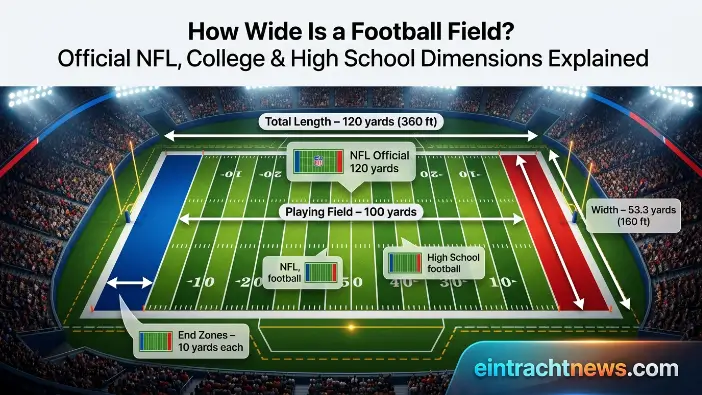
The official width of an American football field is 53⅓ yards, equal to 160 feet or approximately 48.8 meters, measured from one sideline to the other. This standard measurement is used in the NFL, NCAA college football, and most high school football leagues.
The field’s width plays an important role in shaping the game, providing space for offensive formations, passing routes, running plays, and defensive positioning. A wider playing surface could create more opportunities for offensive players to find openings, while a narrower field might restrict movement and affect team strategies.
Length
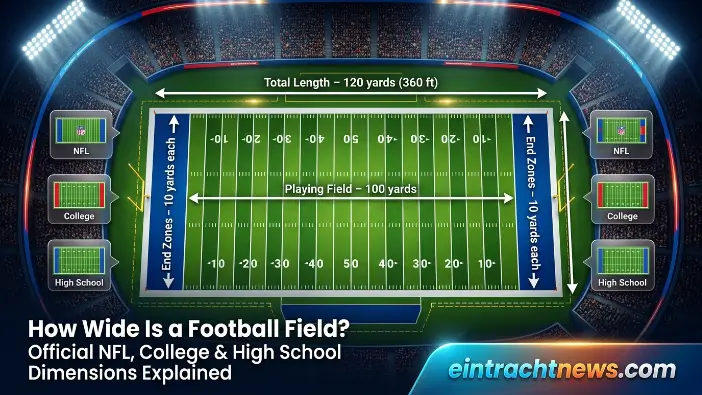
The main playing field in American football measures 100 yards (300 feet) from one goal line to the other. At each end, there is a 10-yard end zone, bringing the total field length to 120 yards (360 feet), or approximately 109.7 meters, when both end zones are included.
End zones play a vital role in scoring, as a player can score a touchdown by carrying the ball into the opponent’s end zone or catching it there according to the rules. The central 100-yard playing area is marked with yard lines and hash marks that help officials track the ball’s position, determine progress toward a first down, and enforce penalties.
Total Area
A regulation American football field covers approximately 57,600 square feet, based on its standard width of 160 feet and total length of 360 feet. This measurement includes the 100-yard playing area along with the two 10-yard end zones at either end of the field.
The large playing surface provides sufficient space for 22 players to compete while carrying out offensive plays, defensive formations, and team strategies. It also supports special teams activities, including kickoffs and punt returns, allowing players to move efficiently while maintaining proper spacing.
Acres Covered
A standard American football field, including both end zones, covers approximately 1.32 acres. Although acres are commonly used to measure land, they also provide a convenient way to visualize the total area of a football field.
For example, when a plot of land is described as being about the size of a football field, it generally refers to an area of around 1.32 acres, based on the field’s full dimensions. This comparison is particularly helpful in real estate, construction, and land development, where familiar reference points make it easier to estimate and understand the size of large areas.
Official Football Field Dimensions
| Measurement | Size |
| Width | 53⅓ yards (160 feet) |
| Playing Length | 100 yards (300 feet) |
| Total Length | 120 yards (360 feet) |
| Total Area | 57,600 square feet |
| Area in Acres | Approximately 1.32 acres |
Read Also: Who played thursday night football
Why Is a Football Field Exactly 53⅓ Yards Wide?
The standard width of an American football field is 53⅓ yards (160 feet). This measurement was established as the sport evolved from rugby during the late 19th century. As American football developed into a more organized game, governing bodies introduced official field dimensions to ensure consistency and fair competition. Today, this standard width is used in the NFL, NCAA college football, and most high school competitions.
The 160-foot width gives offensive and defensive players enough space to carry out their strategies effectively. Offenses can create running lanes, execute passing routes, and spread players across the field, while defenders have room to cover receivers and react to different plays. A significantly wider or narrower field could alter the balance between offense and defense, influencing player positioning and overall tactics.
Are NFL, College, and High School Football Fields the Same Width?
Although American football fields may look different depending on the stadium, their official dimensions generally remain the same across the NFL, NCAA college football, and most high school competitions. A standard field measures 53⅓ yards (160 feet) wide and 120 yards (360 feet) long, including the two 10-yard end zones. These consistent measurements help ensure fair play and provide a uniform playing surface for teams at different levels of competition.
NFL
The National Football League (NFL) uses standardized field dimensions of 53⅓ yards (160 feet) wide and 120 yards (360 feet) long, including both 10-yard end zones. These measurements remain consistent across NFL stadiums, creating a uniform playing environment for every team. Playing surfaces are also carefully maintained to support athlete safety and ensure high-quality competition throughout the season.
One important feature of an NFL field is the spacing of its hash marks, which are set 18 feet 6 inches apart. These markings indicate where the football is placed before each play, keeping it relatively close to the center of the field. Their positioning can affect offensive formations, passing strategies, and defensive alignments, making accuracy, coordination, and strategic planning essential to success in NFL football.
NCAA
College football fields use the same standard dimensions as NFL fields, measuring 53⅓ yards (160 feet) wide and 120 yards (360 feet) long, including both 10-yard end zones. These uniform measurements ensure that NCAA teams play on regulation-sized fields, regardless of their university or stadium.
The primary difference between college and professional football fields is the spacing of the hash marks. In college football, these markings are positioned 40 feet apart, while NFL hash marks are only 18 feet 6 inches apart. This wider spacing changes where the ball is placed before each play and can influence offensive formations, passing angles, and defensive strategies, particularly near the sidelines.
High School
Most high school American football fields use the standard dimensions of 53⅓ yards (160 feet) wide and 120 yards (360 feet) long, including both 10-yard end zones. These measurements give young players the opportunity to develop their skills on a field comparable in size to those used in college and professional football, helping them prepare for more advanced levels of competition.
A key difference is the spacing between the hash marks, which are typically 53 feet 4 inches apart under standard high school rules. This wider spacing influences ball placement before each play and can affect offensive formations, play-calling, and defensive strategies. While some schools may use smaller practice fields due to space limitations, official varsity games generally follow the dimensions and playing rules established by their state athletic associations.
NFL vs. College vs. High School Football Fields
| Feature | NFL | NCAA | High School |
| Field Width | 53⅓ yards | 53⅓ yards | 53⅓ yards |
| Total Length | 120 yards | 120 yards | 120 yards |
| End Zones | 10 yards each | 10 yards each | 10 yards each |
| Hash Mark Spacing | 18 ft 6 in (Narrowest) | 40 ft (Wider) | 53 ft 4 in (Widest) |
Football Field Measurements Explained
Understanding an American football field involves more than simply knowing its width and length. Every line, marking, and boundary has a specific purpose, helping players follow the rules, officials oversee the game, and teams carry out their strategies effectively. From the sidelines and yard lines to the end zones and goalposts, each feature plays an important role in gameplay, scoring, and fair competition.
Sidelines
The sidelines extend along both sides of an American football field and help define its official width of 53⅓ yards (160 feet). These boundary lines separate the playing area from the out-of-bounds zone. When a player carrying the ball steps on or crosses a sideline, the player is considered out of bounds, and the play is stopped.
In addition to marking the field’s limits, the sidelines provide designated spaces for coaches, substitute players, medical personnel, and other team staff. Officials monitor these areas to oversee substitutions, maintain order, and ensure the game continues safely and smoothly.
Goal Lines
The goal lines are located at each end of the 100-yard playing field, separating the main playing area from the two 10-yard end zones. These lines are among the most important markings on an American football field because they determine whether a team has scored a touchdown.
A team earns six points when a player legally carries the football across the opponent’s goal line or catches a pass in the end zone while satisfying the rules for a completed catch. On close scoring plays, officials carefully review the ball’s position and the player’s possession to determine whether the requirements for a touchdown have been met.
End Zones
Each end zone is 10 yards deep, adding 20 yards to the main 100-yard playing field and bringing the total length of a regulation American football field to 120 yards (360 feet). Located beyond each goal line, these areas are where teams score touchdowns by legally advancing the ball into the opponent’s end zone.
Beyond their importance in scoring, end zones often display the home team’s name, logo, and colors, giving each stadium a distinctive look. They also provide space for touchdown celebrations and play a role in certain special teams situations, making them an important part of both the game and the overall stadium experience.
Hash Marks
Hash marks are short lines that run across the middle of the field and indicate where the ball is placed before each play begins. They he Hash marks are small lines painted across an American football field that help officials accurately determine where the ball should be placed before each play. Their positioning varies by league, affecting where offensive plays begin and how teams use the available space across the field.
Hash mark spacing varies by league:
- NFL: 18 feet 6 inches apart
- NCAA college football: 40 feet apart
- High school football: 53 feet 4 inches apart
These differences influence offensive formations, passing angles, and the amount of space available on either side of the ball. For this reason, hash mark placement is an important factor in football strategy, play design, and decision-making.
Yard Lines
American football fields feature yard lines that extend across the width of the field at 5-yard intervals, with yard numbers usually displayed every 10 yards to help identify field position. These markings make it easier for players, coaches, officials, and spectators to track the action and understand how far a team is from the end zone.
Yard lines play a crucial role in measuring progress toward a first down, identifying the line of scrimmage, enforcing penalties, and tracking a team’s movement down the field. They also help officials monitor each play accurately and ensure the game is conducted according to the rules.
Goal Posts
The goalposts are positioned at the back of each end zone and are used for field goals and extra-point attempts. For a kick to count, the football must pass between the two uprights and above the crossbar.
In the NFL, the uprights are spaced 18 feet 6 inches apart. College and high school football may use different goalpost specifications, depending on the applicable rules. Although the overall field dimensions remain consistent, goalpost width plays an important role in kicking accuracy, technique, and game strategy.
Football Field Width Compared With Other Sports
While an American football field has a fixed regulation width of 53⅓ yards (160 feet), the dimensions of playing surfaces in other sports can vary significantly. Each sport is designed with unique rules, player numbers, and gameplay styles, which is why field and court sizes are not the same. Comparing these dimensions helps put the size of a football field into perspective.
| Sport | Typical Width |
| American Football | 53⅓ yards (160 feet) |
| Soccer (FIFA) | 50–100 yards |
| Rugby Union | About 76 yards |
| Canadian Football | 65 yards |
| Basketball Court | 50 feet |
| Baseball | No fixed field width |
This comparison shows that every sport uses dimensions that best suit its style of play. The standardized width of an American football field helps maintain balanced gameplay, consistent strategies, and fair competition across every level of the sport.
Common Mistakes People Make
When exploring American football field dimensions, some official measurements can be confusing, particularly the total field length, the size of the end zones, and the differences between professional, college, and high school fields. Understanding these key details makes it easier to recognize the standard field dimensions and understand the purpose of its various markings.
Common mistakes about American football field dimensions include:
- Confusing football with soccer: Soccer field sizes vary, while American football fields follow standard measurements.
- Ignoring end zones: The two 10-yard end zones bring the total field length to 120 yards.
- Assuming different field sizes: NFL, NCAA, and most high school fields share the same standard dimensions.
- Mixing measurement units: Converting yards, feet, and meters can cause confusion.
- Misunderstanding hash marks: Their spacing varies by league but does not change the field’s width.
Understanding these points makes American football field dimensions easier to remember.
Tips for Remembering Football Field Dimensions
Remembering American football field dimensions is easy when you focus on a few essential measurements. With these simple memory tips, you can recall the official dimensions quickly whenever needed. These techniques are particularly useful for students, new fans, and anyone learning the fundamentals of the game.
This is the playing area between the two goal lines:
120 yards in total: Including both 10-yard end zones, the complete field measures 120 yards long.
Approximately 1.32 acres: The entire field, including both end zones, covers about 1.32 acres.
A simple way to remember these measurements is the “53–100–120 Rule.” Remember that the field is 53⅓ yards wide, the playing area is 100 yards long, and the total length is 120 yards.
Frequently Asked Questions
Why is the width of an American football field standardized?
A standardized field width ensures every team plays under the same conditions, making the game fair and allowing strategies to remain consistent across different stadiums and competitions.
Does the size of a football stadium affect the field dimensions?
No. Stadiums can vary in seating capacity and overall size, but the playing field must follow the official regulation dimensions set by the governing league.
Are football field dimensions the same in every country?
American football fields generally follow the same official measurements worldwide, especially in leagues that adopt NFL or NCAA rules. Minor differences may exist only in recreational or youth leagues.
Why are football field measurements given in yards instead of meters?
American football originated in the United States, where the imperial system is traditionally used. That’s why official field dimensions are measured in yards and feet, although metric conversions are often provided for international audiences.
Can practice football fields have different dimensions?
Yes. Practice fields may be shortened or modified to fit available space or specific training drills. However, official matches are played on regulation-sized fields that meet league standards.
Conclusion
If you’ve ever asked yourself how wide is a football field, the answer is straightforward: a regulation American football field measures 53⅓ yards across, which equals 160 feet or approximately 48.8 meters. This standard width applies to the NFL, college football, and most high school games, ensuring consistency in the sport.
In addition to width, learning the complete football field dimensions including the 100-yard playing field, 10-yard end zones, hash marks, and other important markings can help you better understand gameplay and strategy. Whether you’re a fan, player, coach, or student, knowing these measurements provides a clearer understanding of the field layout and the rules of American football.
