

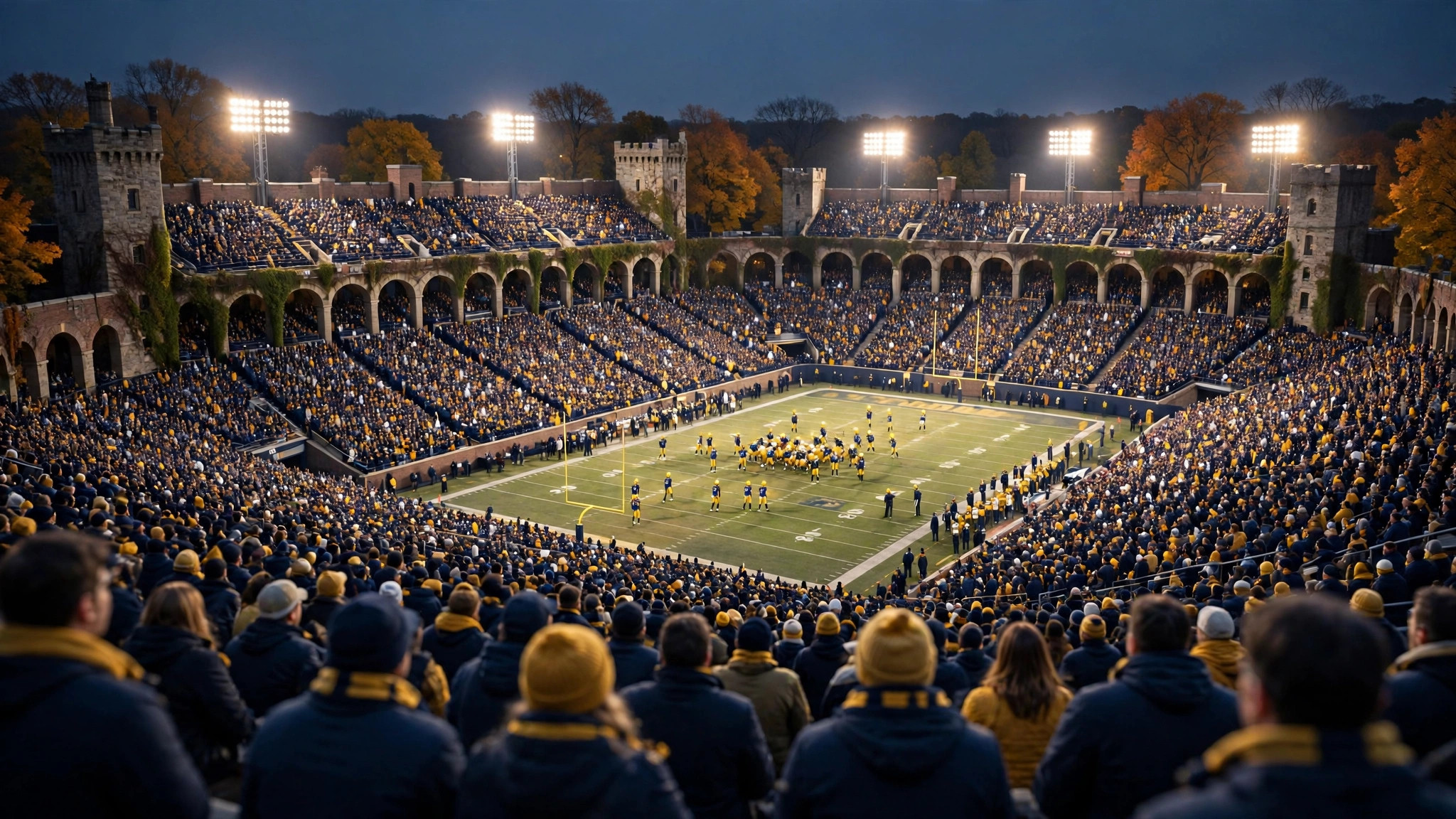
No program in American sports carries quite the mythology of Notre Dame. The golden helmets, the mural watching over the stadium, the fight song every marching band on earth seems to know — notre dame football is not just a team, it is one of the country’s great sporting institutions, and it has been for more than a century.
This guide is your complete introduction: the history, the independence that sets the Irish apart, the stadium Knute Rockne built, the traditions that still govern every Saturday in South Bend, and the practical basics of following the team today. Whether you grew up on the Victory March or are meeting the Irish for the first time, here is notre dame football in full.
Notre Dame Football: An Institution Like No Other
Start with the basics that never change. Notre Dame plays in South Bend, Indiana, wears navy blue and metallic gold, and fields its football team as an independent — a status we will explore in depth shortly, because it shapes everything about the program. The team claims 13 national championships, a total that places it among the most decorated programs in the history of the sport.
The head coach is Marcus Freeman, whose tenure has carried the program’s enormous expectations into the modern playoff era. Freeman coaches under a spotlight unlike any other in college football, because Notre Dame’s fan base is not regional — it is genuinely national, built over generations of subway alumni, national television, and Saturday afternoons that became family rituals from coast to coast.
That national footprint is the program’s superpower. Notre Dame recruits everywhere, plays everywhere, and matters everywhere. A home game in South Bend is a pilgrimage site for fans who may live a thousand miles away and have never set foot in Indiana before kickoff weekend.
ND Football
Ask casual fans what conference nd football plays in and you will start an argument, because the answer is: none, and proudly so. Notre Dame football remains an independent, scheduling its own national slate each year while the rest of the sport sorts itself into ever-larger conferences. The rest of the university’s sports compete in the ACC, but football guards its independence like a birthright.
Independence is strategy, not stubbornness. It lets Notre Dame build a schedule that reads like a national tour — coast to coast, against historic rivals and marquee names — and it underpins the program’s unique television identity, with home games in South Bend traditionally broadcast nationally by NBC. No other program has anything quite like that arrangement, because no other program is quite like this one.
The trade-off is real, too. There is no conference championship game to win and no league safety net in a down year; the Irish live and die by their national schedule and the playoff picture it creates. Fans would not change a thing. Independence is not a detail of nd football. It is close to the whole point.
Notre Dame Fighting Irish Football
The story of notre dame fighting irish football is, in large part, the story of college football itself. The program rose to national fame in the 1920s under Knute Rockne, the legendary coach whose teams turned a small Indiana school into a coast-to-coast phenomenon and whose name still hangs over the stadium he built.
Era followed era. The Irish produced Heisman winners, undefeated seasons, and afternoons that entered American folklore. The program’s championship tradition — those 13 claimed national titles — spans generations of coaches and players, and each era left the next one a standard that borders on unreasonable. That is life at Notre Dame: the past is always in the room.
What keeps notre dame fighting irish football vital is that the story never stopped. The names change, the game evolves, the playoff formats multiply, and every September a new roster walks into the same tunnel under the same sign, carrying the same expectation: compete for everything, accept nothing less, and understand exactly whose jersey you are wearing.
Notre Dame Football News
Because the fan base is national, notre dame football news operates at a scale few programs can match. Every practice report, recruiting rumor, and depth-chart shuffle becomes a headline somewhere, and the modern fan’s challenge is not finding coverage — it is sorting the signal from the noise.
The smart routine starts with official sources. The university’s athletics site, UND.com, publishes schedules, roster updates, and confirmed news first, and it should anchor any fan’s bookmarks. National outlets cover the Irish heavily, and dedicated Notre Dame media provide the daily depth — podcasts, film breakdowns, and recruiting coverage — that the size of this fan base demands.
A few habits will keep your news diet healthy:
- Lead with official announcements for injuries, schedules, and kickoff times
- Treat social-media rumors as entertainment until a credible outlet confirms them
- Follow the schedule a week at a time; our Notre Dame football schedule guide shows the season’s full shape
- Remember that at Notre Dame, the offseason is a season — recruiting and spring ball draw enormous interest
Football Notre Dame Fighting Irish
The phrase football notre dame fighting irish might sound like a jumble of search terms to an outsider, but to fans it is a checklist of sacred things. Start with the Play Like a Champion Today sign, slapped by every player on the way out of the locker room — a simple board with four words that has become one of the most famous rituals in sports.
Then there are the golden helmets, painted with real gold dust in the program’s tradition, gleaming under the South Bend lights in a way television only half captures. Add the Victory March, the fight song composed more than a century ago and still the soundtrack of every Irish Saturday, and the picture completes itself: this program does not have traditions so much as it is one, continuous tradition with a football team attached.
Game day adds its own layers. The band’s pregame performance, the player walk through crowds of fans, the hush that falls over the stadium at certain moments — South Bend on a football Saturday operates with the rhythm of a place that has rehearsed the same beautiful ceremony for a hundred years and never once gotten tired of it.
Notre Dame Stadium
Every guide to the Irish ends up in the same place: notre dame stadium, which opened on October 4, 1930, and is forever known as “the House That Rockne Built.” The stadium seats 77,622 fans today, and walking its concourses feels like walking through the sport’s memory — because so much of that memory happened right here.
The stadium’s most famous neighbor is not part of the building at all. From inside the bowl, fans can see the great mural on the library tower beyond the north end zone — the artwork universally known as Touchdown Jesus, arms raised in a pose that generations of fans insist looks exactly like a referee signaling a touchdown. It is the most famous backdrop in college football, full stop.
A visit to notre dame stadium rewards early arrival. Tour the grounds, find the statues, watch the band step off, and be in your seat as the Irish take the field. Some stadiums are bigger and some are newer, but very few places in American sports feel this saturated with meaning. If you plan only one college football pilgrimage in your life, South Bend argues its case about as well as anywhere can.
How the Roster Is Built in South Bend
Recruiting at Notre Dame is a national operation with a particular filter: the university’s academic standards and identity shape the pool, and the staff recruits players who fit both the depth chart and the school. The result, at its best, is a roster stacked with talent that chose Notre Dame deliberately — a distinction the program wears with pride.
The modern Irish roster blends high school recruiting with selective use of the transfer portal, and following its construction is a year-round hobby for fans. For a sense of how game length and pacing shape a season’s demands on a roster, our explainer on how long a football game lasts is a useful companion read.
What matters most on Saturdays is simpler: depth in the trenches, a defense that travels, and quarterback play steady enough to survive a schedule with no soft conference landing spots. Independence means every opponent is a headline, and the roster has to be built like it.
Tickets and the South Bend Experience
Notre Dame home games are among the toughest tickets in the sport, and the demand is generational — alumni lotteries, visiting fans making their one big trip, and neutrals who simply want to see the place once. Planning early is not advice here; it is survival. Official university channels are the safest route for tickets and the full weekend schedule.
Build the whole weekend if you can. Friday in South Bend has its own traditions, from the band’s rehearsal atmosphere to the grotto and the basilica on one of America’s prettiest campuses. On Saturday, tailgating spreads across the lots in a festival of navy and gold, and the walk into the stadium with 77,622 of your closest friends does the rest.
Fans comparing bucket-list trips often pair South Bend with other historic venues — our Duke football guide covers a very different but equally tradition-soaked campus experience. The Irish weekend, though, stands alone: part football game, part homecoming for a fan base that lives everywhere.
Frequently Asked Questions
What conference does Notre Dame football play in?
None — Notre Dame football is an independent, building its own national schedule each year, while the university’s other sports compete in the ACC.
How many national championships does Notre Dame claim?
The program claims 13 national championships across its history, placing it among the most successful programs in college football.
When did Notre Dame Stadium open?
The stadium opened on October 4, 1930, and is known as “the House That Rockne Built,” with a current capacity of 77,622.
Who is Notre Dame’s head coach?
Marcus Freeman leads the Fighting Irish, carrying one of the most demanding and visible jobs in American sports.
The Bottom Line
Notre Dame football endures because it is bigger than any single season. The independence, the golden helmets, the sign above the tunnel, Touchdown Jesus watching over it all — the Irish are college football’s longest-running argument that tradition, done properly, is a competitive advantage.
Follow the news daily if you like, or simply show up on Saturdays in the fall. Either way, notre dame football will be exactly where it has always been: at the center of the sport, on national television, playing like champions today.
