

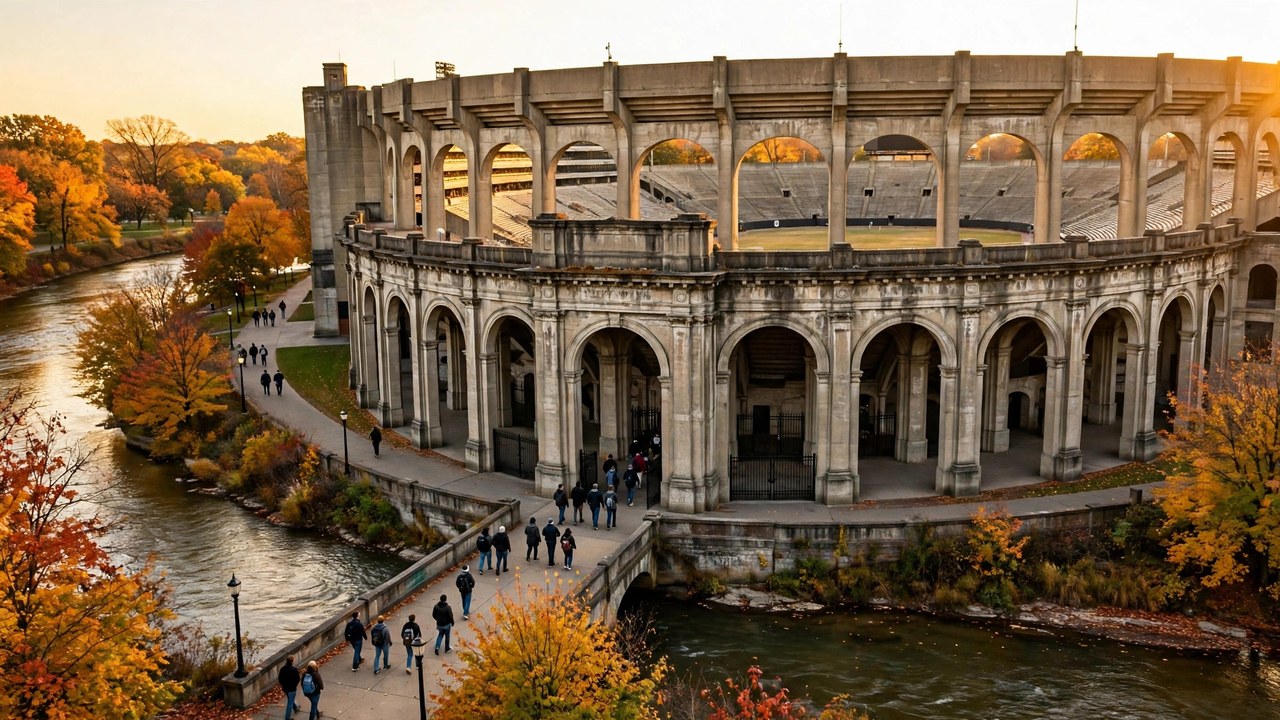
There is no building in college football quite like Ohio Stadium. Rising over the Olentangy River in Columbus, the giant concrete horseshoe has been the home of the Ohio State Buckeyes since 1922, and more than a century later it remains one of the largest and loudest stadiums in the United States. This guide covers the story of Ohio Stadium — how it was built, how it grew past 100,000 seats, where to sit, and what game day inside the ‘Shoe actually feels like.
Ohio Stadium is also a piece of architectural history. When it opened, it was the largest poured-concrete structure in the world, an audacious project for a university whose team had been playing on a field that held barely a quarter of its capacity. Skeptics predicted it would never fill. They were wrong for about a hundred consecutive years.
The History of Ohio Stadium
Ohio Stadium exists because of Chic Harley. The Buckeyes’ first three-time All-American drew crowds so large in the late 1910s that little Ohio Field could not contain them, and the stadium that replaced it is still sometimes called “the House That Harley Built.”
The university launched a public fundraising campaign in 1920, and Columbus architect Howard Dwight Smith — an Ohio State graduate — designed a double-decked horseshoe unlike anything in America. Construction cost about $1.34 million, and Ohio Stadium opened on October 7, 1922, with the Buckeyes beating Ohio Wesleyan. The dedication game two weeks later against Michigan drew more than 76,000 fans, far beyond the listed capacity of 66,210, as thousands stood along the sidelines and the running track.
The decades since have been a story of constant growth:
- 1940s–1990s: Temporary bleachers, then permanent south stands and upper decks, pushed capacity steadily toward 95,000.
- 1999–2001: A sweeping renovation lowered the playing field by about 14 feet, removed the running track, built permanent south stands and added suites and club seats, lifting capacity past 100,000.
- 2014–2017: Additional seating and later aisle and accessibility work settled the official capacity at today’s figure.
Ohio Stadium was added to the National Register of Historic Places in 1974, a rare honor for a working sports venue, and you can verify the building’s full timeline on its Wikipedia reference page.
Ohio Stadium Facts at a Glance
- Opened: October 7, 1922
- Architect: Howard Dwight Smith
- Original capacity: 66,210
- Current capacity: 102,780
- Record attendance: 110,045 (vs Michigan, 2016)
- Surface: Artificial turf
- Nickname: The Horseshoe, the ‘Shoe
- Historic status: National Register of Historic Places, 1974
Those numbers only tell part of the story. Ohio Stadium has been expanded or renovated in nearly every era of its life, which is why parts of the building feel like 1922 and parts feel like a modern NFL facility. The 1999–2001 project alone reconfigured the lower bowl, added the press box and suite levels, and rebuilt the south end — all while keeping the rotunda and the horseshoe silhouette untouched.
Famous Games at the Horseshoe
Some buildings collect famous afternoons the way Ohio Stadium collects famous Novembers. The 2002 Michigan game sent an undefeated Ohio State team to the national championship game and restarted the program’s modern title era. Four years later, the 2006 meeting with Michigan matched the nation’s No. 1 and No. 2 teams in what was instantly dubbed the Game of the Century, and the Buckeyes won a shootout that lived up to the billing.
The 2016 Michigan game may be the loudest of all. Played before that record crowd of 110,045, it went to double overtime and turned on a fourth-down spot that Buckeye fans still celebrate and Michigan fans still dispute — which is exactly what a great rivalry game is supposed to produce. Add the 2014 team’s run, generations of Rose Bowl-clinching wins over Michigan, and countless top-five matchups under the lights, and the ‘Shoe’s highlight reel is as deep as any stadium’s in America.
Night games deserve a special mention. Ohio Stadium hosted its first night games only occasionally for decades, but modern scheduling has made prime-time kickoffs in Columbus a regular spectacle, with the stadium’s light shows and a full day of tailgating behind them.
Ohio State Game
An Ohio State game at the Horseshoe is an all-day event, and the rituals start hours before kickoff. Fans pour across the river bridges from tailgate lots at dawn. Two hours before the game, thousands pack St. John Arena across the street for the Skull Session, the marching band’s traditional pep rally and rehearsal that has become a show in its own right.
Back at Ohio Stadium, the pregame builds in layers:
- The marching band’s ramp entrance and the playing of the national anthem
- Script Ohio, the band’s famous formation, capped by a senior sousaphone player dotting the “i”
- The team’s entrance to a wall of noise from more than 100,000 fans
During the game itself, the south stands host Block O, the official student section, whose card stunts and coordinated cheers set the tone for the building. When the Buckeyes win, the crowd lingers to sing “Carmen Ohio,” the alma mater, with the team at midfield — a quiet, arm-in-arm tradition that contrasts with the noise that came before it.
For fans mapping out the season around a trip to Columbus, our Ohio State football schedule guide shows which dates bring the biggest games to the ‘Shoe each year.
Capacity and Seating Guide
Today’s official Ohio Stadium capacity is 102,780, which places it among the very largest stadiums in the country. The record crowd is 110,045, set against Michigan in 2016, when standing-room and temporary seating pushed the building well past its listed number.
The seating bowl is organized into decks that help first-time visitors decode their tickets:
- A Deck: The lower bowl on the east and west sides — closest to the field and the most traditional seats in the house.
- B Deck: The middle tier, tucked partly beneath the upper deck, with a good balance of view and shelter from weather.
- C Deck: The upper deck, steep and high, offering a full-field view that coaches and serious students of the game love.
- South Stands: Home to Block O and the band, with the most energetic atmosphere in the stadium.
- Suites and club seats: Added in the 2001 renovation along the west side and in the south stands.
Because the track was removed in the renovation, even the first rows sit close to the field by modern standards, and the lowered playing surface gives the bowl a steeper, louder feel than its age suggests.
The Rotunda and the Architecture
The north end of Ohio Stadium is its signature. The rotunda — a domed entrance framed by arches and stained-glass windows depicting players — looks more like a Roman monument than a football gate, and it has been the stadium’s postcard image for a century.
Smith’s design was radical for 1922. The double-deck structure, the first of its kind at a college stadium, stacked fans closer to the action instead of spreading them outward, and the open south end preserved the horseshoe shape that gives the stadium its nickname. The original design even included a dormitory, Stadium Scholarship Dorms, where students once lived inside the west side of the building in exchange for working around the athletic department.
Walking the concourses, you will find tributes to the program’s greats: retired numbers including Chic Harley’s 47, Archie Griffin’s 45 and Eddie George’s 27, plus championship markers celebrating Ohio State’s nine claimed national titles.
A Game Day Timeline at Ohio Stadium
If you are visiting for the first time, the day runs on a rhythm regulars know by heart:
- Six hours before kickoff: Tailgate lots open and the first grills fire up around the stadium and along the Olentangy.
- Three hours before: The team arrives for the walk to the stadium, and Lane Avenue and the St. John Arena area reach peak crowd.
- Two hours before: The Skull Session begins inside St. John Arena — arrive earlier than that if you want a seat.
- Thirty minutes before: The band takes the field for its ramp entrance, and the stadium fills to capacity.
- Kickoff: The noise peaks. For Michigan or a top-ten visitor, expect the loudest sustained roar in the Midwest.
- After the game: The team and crowd sing “Carmen Ohio,” and traffic out of campus takes its time — most veterans head back to the tailgate and wait it out.
Food inside the stadium covers the expected range of hot dogs, brats and nachos, plus Columbus touches that rotate by season. Concourse lines are shortest during the first quarter and at halftime’s opening minutes. The stadium has also steadily upgraded its concourses, restrooms and video boards in recent renovation phases, so the experience inside is more modern than the 1922 exterior suggests.
Tickets and Visiting Fan Tips
Ohio Stadium tickets are a serious commitment. Season seats are allocated through the university’s donor and alumni points system, and single-game tickets for Michigan, Penn State or a top-ten non-conference visitor rarely survive the public sale. The resale market is the practical option for most visitors, with prices that swing wildly based on the opponent and the weather forecast.
Practical advice for first-timers:
- Stay near campus or downtown: Hotels fill a year ahead for rivalry weekends; the Arena District and Short North are the usual fallbacks.
- Use the bus or rideshare: Game-day parking is permit-controlled across most of campus.
- Dress for November: Columbus cold is a real factor late in the season, and Ohio Stadium’s concrete holds the chill.
- Plan the full day: Between the Skull Session, tailgating and the postgame sing, a noon kickoff still makes for a ten-hour event.
If your trip is an away game instead, our guide to watching Ohio State vs Purdue explains how to follow the Buckeyes on the road, and the matchup breakdown of Indiana vs Ohio State player stats shows what to watch for in a Big Ten box score.
More Than Football
Ohio Stadium moonlights as one of Ohio’s biggest entertainment venues. It hosts the university’s spring commencement, which fills the stands with graduates each May, and it has staged concerts by acts such as U2, the Rolling Stones, Pink Floyd and Taylor Swift, along with the annual Buckeye Country Superfest.
Soccer has a chapter in the stadium’s history too. The Columbus Crew of Major League Soccer played their first three seasons, from 1996 to 1998, at Ohio Stadium before moving into the first soccer-specific stadium in the United States. It is a fitting footnote for a building that has spent a century being bigger than anyone expected.
Frequently Asked Questions
When did Ohio Stadium open?
Ohio Stadium opened on October 7, 1922, and its dedication game against Michigan followed two weeks later.
What is Ohio Stadium’s capacity?
The official capacity is 102,780. The record attendance is 110,045, set against Michigan in 2016.
Why is it called the Horseshoe?
The stadium’s open-ended, U-shaped bowl resembles a horseshoe, and the nickname “the ‘Shoe” has stuck for a century.
Who designed Ohio Stadium?
Columbus architect Howard Dwight Smith, an Ohio State alumnus, designed the stadium, pioneering the double-deck style in college football.
Where is the student section at Ohio Stadium?
Block O, the official student section, sits in the south stands and leads many of the stadium’s coordinated cheers and card stunts.
