

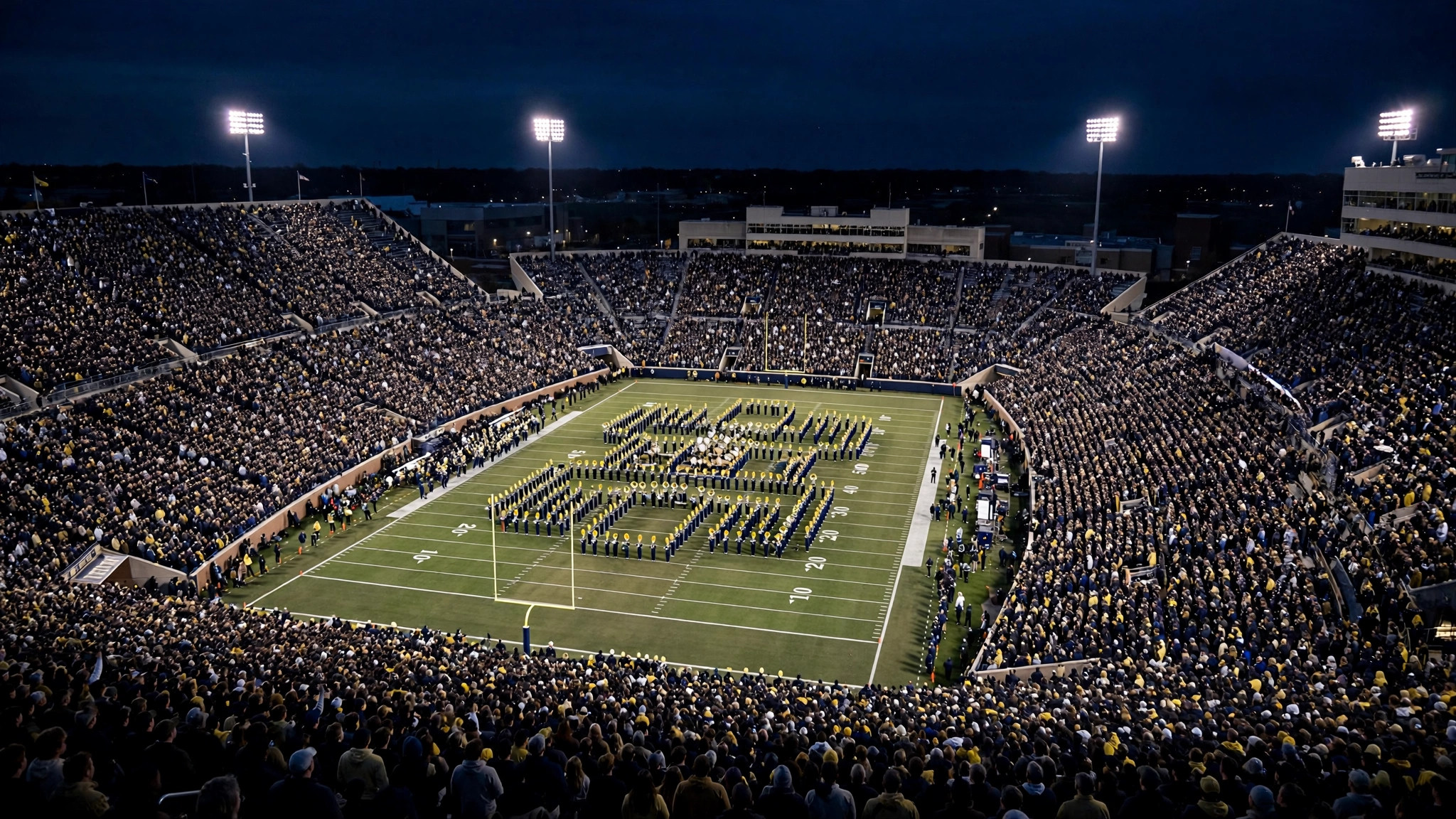
There is nothing in American sports quite like a Saturday in the fall. College football fills hundred-thousand-seat stadiums, shuts down entire towns, and turns students, alumni, and lifelong locals into one loud, coordinated crowd. If you are new to the sport, or you simply want the full picture in one place, this guide explains how college football works from its first game in 1869 to the modern playoff era.
We will cover the history, the structure of the season, the conferences and divisions, the rules that make the college game different, and the traditions that keep fans coming back for generations. By the end, you will know how to follow a season from the late-August kickoff to the national championship game in January.
A Short History of the College Game
The first intercollegiate game was played on November 6, 1869, between Rutgers and Princeton in New Brunswick, New Jersey. It barely resembled the modern sport: it was played under soccer-style rules, with 25 players a side, and Rutgers won 6-4. What it started, though, changed American sports forever.
In the 1880s, Yale’s Walter Camp reshaped the game into something distinct. Camp is widely called the Father of American Football because he introduced the line of scrimmage, the snap from center, and the down-and-distance system that still organizes every play today. The forward pass was legalized in 1906, opening the game up and making it safer and more varied.
Through the twentieth century, the sport grew with the universities themselves. Polls decided champions for decades, bowl games became holiday institutions, and television turned regional rivalries into national events. The Bowl Championship Series arrived in 1998, the College Football Playoff replaced it with a four-team bracket in 2014, and the playoff expanded to 12 teams starting with the 2024 season.
Our dedicated history piece on who invented American football goes deeper on Camp and the early rule-makers if you want the full story.
Football
The word football means different things around the world, but in the United States the college version sits between high school and the NFL in a structure run largely by the NCAA. The top level is the Football Bowl Subdivision, or FBS, home to the famous programs, the giant stadiums, and the College Football Playoff.
Below the FBS sits the Football Championship Subdivision, or FCS, which decides its champion through a traditional multi-round playoff. Divisions II and III run their own championships as well. That layered system means hundreds of schools field teams, each playing for something real in November and December.
Within the FBS, schools belong to conferences — regional and national groupings such as the Big Ten, the SEC, the ACC, and the Big 12. Conference membership shapes a team’s schedule, its television exposure, its recruiting footprint, and its path to the postseason. Realignment has redrawn the map repeatedly in recent years, but conferences remain the sport’s basic organizing unit.
College Football Games
A typical FBS team plays 12 regular-season games, usually starting in late August or early September and finishing in late November. Most games fall on Saturdays, with a growing number of Thursday and Friday night showcases mixed in. Each team gets bye weeks built into the schedule for rest.
The calendar builds in a familiar rhythm:
- Late August to September: Non-conference games, including marquee intersectional matchups and early rivalry tests.
- October: The heart of conference play, when standings take shape and ranked teams start eliminating each other.
- Late November: Rivalry week, the emotional peak of the regular season, when the most famous grudge matches in the sport are played.
- Early December: Conference championship games, matching the best teams in each league.
- Mid-December to January: Bowl season and the College Football Playoff, ending with the national championship game.
After the regular season, the College Football Playoff selection committee ranks the top 25 teams. In the current 12-team format, the five highest-ranked conference champions earn places along with the next seven highest-ranked teams, and the bracket plays out through on-campus first-round games, bowl-hosted quarterfinals and semifinals, and a neutral-site final.
College Football Game
The college game shares its skeleton with the NFL — four quarters, downs, touchdowns worth six points — but several rules are distinctly its own. Knowing the differences helps everything else make sense.
College overtime is unique. Teams take turns with possessions from the opponent’s 25-yard line, and from the third overtime onward, teams run two-point conversion plays instead of full drives. A player is also ruled down with just one foot in bounds for a catch, unlike the NFL’s two-foot requirement.
Other basics worth knowing:
- A college game is divided into four 15-minute quarters, with a 20-minute halftime. Our guide to how many quarters are in football breaks down the timing in detail.
- The clock stops after first downs in key late-game situations under current rules, which helps produce the sport’s famous frantic finishes.
- Targeting rules are strict: a player ejected for targeting sits out, and if the foul happens in the second half, the suspension carries into the next game’s first half.
- There is no two-minute warning tradition like the NFL’s, though a two-minute timeout was recently added to the college game.
Field dimensions are standardized too — 120 yards long including the end zones — and our explainer on how long a football field is covers the measurements fans always ask about.
Rankings, Polls, and the Playoff Picture
Few sports argue about rankings as happily as this one. Two traditional polls — the Associated Press Top 25, voted on by media members, and the Coaches Poll — publish every week of the season. They do not officially decide the playoff field, but they frame the national conversation from September onward.
Late in the season, the College Football Playoff selection committee takes over the spotlight. The committee releases its own Top 25 rankings over the final weeks, and only its final ranking matters for the bracket. That weekly reveal has become a television event of its own, because a team’s position in November tells fans exactly what it still needs: win out, get help, or hope the committee values its schedule kindly.
Understanding the difference between the polls and the committee saves a lot of confusion. The AP Poll is a snapshot of opinion and history. The committee ranking is a working document with direct consequences — seeds, byes, home games, and ultimately the national championship path all flow from it.
Bowl Season: The Sport’s Winter Festival
Even in the playoff era, bowl games remain one of the sport’s defining features. Dozens of postseason games are played from mid-December through early January, mostly at warm-weather or neutral sites, matching teams from different conferences that rarely meet in the regular season.
For players, a bowl trip is a reward: a week of events, gifts within NCAA limits, and one last game together for seniors. For fans, it is a travel tradition and a television feast, with games filling the holiday calendar almost daily. The biggest bowls — the Rose, Sugar, Orange, Cotton, Fiesta, and Peach, often called the New Year’s Six — rotate through the playoff’s quarterfinal and semifinal rounds, which keeps their history connected to the championship race.
Not every bowl carries playoff stakes, and that is honestly part of the charm. A December game between two seven-win teams can still produce a classic finish, a breakout young quarterback, and a memory a fan base keeps for years.
The Traditions That Make It Different
Ask a fan why this sport matters and you will rarely hear about television contracts. You will hear about marching bands spelling out a school’s name, about a team running onto the field touching a rock, a sign, or a statue, and about tailgate recipes that have been in a family for forty years.
Traditions are the sport’s memory. The pageantry — fight songs, student sections, senior days, homecoming weekends — connects a freshman in the stands to graduates who sat in the same seats decades earlier. Rivalry trophies, some of them wonderfully strange, give regular-season games a weight that no other American sport quite matches.
That emotional layer also explains the sport’s economics. Alumni loyalty drives donations, applications, and ticket demand. When a team wins big, applications to the university often rise the following year — a reminder that on campus, the football team is the front porch of the whole institution.
How to Follow a Season Like a Regular
Getting into the sport is easier than it looks. Start with one team — your local school, your alma mater, or a program whose style you enjoy — and follow its schedule week to week. Add the big national games around it, and by October you will understand the playoff picture almost by instinct.
A simple weekly routine works well:
- Check your team’s kickoff time and TV channel early in the week.
- Glance at the conference standings so you know what each game means.
- Watch at least one big game outside your team’s conference each Saturday.
- Read the updated playoff rankings when the committee releases them late in the season.
For the official standings, statistics, and rankings across the sport, the overview of NCAA Division I FBS football is a useful reference for how the top level is structured and scheduled.
Frequently Asked Questions
When does the college football season start and end?
The regular season begins in late August or early September and ends in late November. Conference championships follow in early December, and bowl games plus the playoff run through the national championship game in January.
How many teams make the College Football Playoff?
The playoff expanded to 12 teams starting with the 2024 season. The five highest-ranked conference champions qualify, along with the seven next highest-ranked teams chosen by the selection committee.
What is the difference between FBS and FCS?
The FBS is the top level, decided by the College Football Playoff and bowl games. The FCS is the second level of Division I and crowns its champion through a traditional seeded playoff tournament.
How long does a college football game last?
Most games run about three to three and a half hours of real time, even though the game clock totals 60 minutes, because of timeouts, halftime, reviews, and television breaks.
Why are conferences so important?
Conferences set schedules, crown champions, negotiate television deals, and provide the automatic playoff paths. A team’s conference largely determines who it plays and what its season can become.
The Bottom Line
College football is part sport, part homecoming, and part regional identity stitched into one Saturday ritual. Its history runs from a soccer-like game in 1869 through Walter Camp’s rulebook to a 12-team playoff watched by millions.
Learn one team’s schedule, understand the conference map, and let the rivalries pull you in. The rest — the polls, the playoff math, the bowl calendar — falls into place naturally once the Saturdays start to matter to you.
